


Magazine Archive
Home -> Magazines -> Issues -> Articles in this issue -> View
C-ducing Cymbals | |
Article from Home & Studio Recording, April 1985 | |
Electronic drum kits give superb sound separation for the studio engineer - but he still has to mike up the cymbals. We investigate a novel application for the C-ducer contact strip microphone, which helps alleviate this problem.
Electronic drum kits have proved to he the salvation of many home studios hut as you still need 'acoustic' cymbals, the old problem of separation still rears its ugly head. Paul White tries out the C-ducer solution to this perennial problem and makes some interesting discoveries.
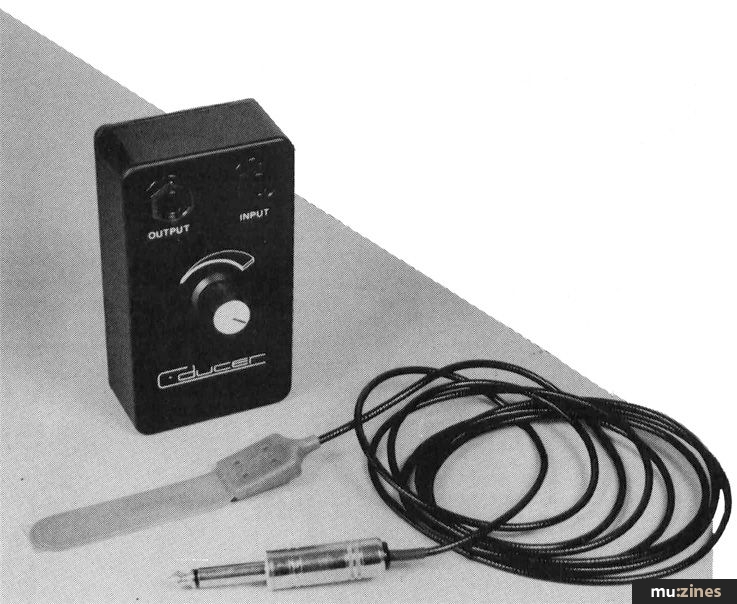
Like many of our readers, I use an electronic drum kit in my home studio, but as yet I have found no satisfactory substitute for real cymbals. Electronic kits offer almost perfect signal separation so it's a real pain when the sound of the rest of the band bleeds into the cymbal microphones. Obviously, I was as keen to find a way around this problem as you undoubtedly are, so I decided to try out the C-ducer tape transducer system, in this case the model B1/3. This comes complete with its own battery-powered pre-amp and a large reel of double-sided fixing tape so all you have to do is fit a PP3 style battery and plug the pre-amp into a line input on your mixer.
Positioning C-ducer
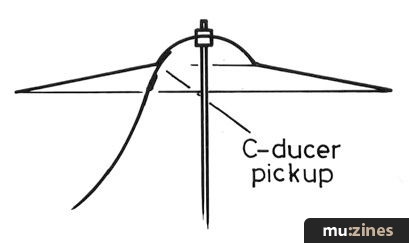
Figure 1a.
The first victim of my experiment was a 16" Paiste crash/ride cymbal and I tried various positions of attachment with the following result. Firstly, it is only practical to stick the end inch or so of the C-ducer to the cymbal, otherwise the sound is severely deadened, and secondly, the best point of attachment is on the underside of the bell because this position again interferes least with the cymbals' sound (see Figure 1a).
Sound Achievement
As with any bright sound source, the recording levels should be kept fairly low (ie. peaking at -10dB) and it is a good idea to roll off some of the bass to avoid ending up with a 'gong' sound.
In order to produce a convincing sound, a bit of experimentation in the EQ department is called for either at the recording or mixing stage, as the C-ducer tends to emphasise the low frequency overtones and suppress the bright ones. I ended up cutting the bass completely, cutting some of the lower mid (around 400Hz) and adding a little top which gave a reasonable result, albeit totally lacking in ambience which is, of course, to be expected when using contact style microphones. Just a hint of reverb improved this state of affairs enormously but the main improvement was achieved by connecting an 'Aural Exciter' to the system and this restored the 'zing' that had somehow been lost along the way.
I know that most of you will say "Groan - I haven't got an Aural Exciter", but I have heard from a reliable source that a cheaper device offering essentially the same benefits will shortly be available from Bandive and will be priced to fall in line with their Accessit range of products.
Hi-Hats
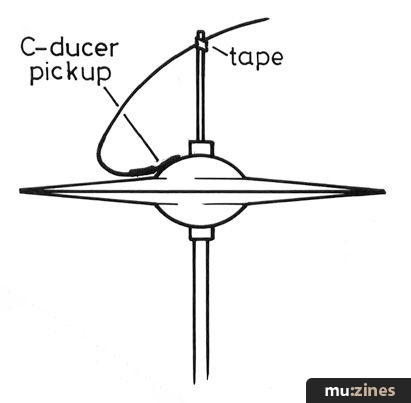
Figure 1b.
Here too, the C-ducer has to be attached to the bell of the cymbal, in this case the top one, otherwise the sound is again damped. It can't, of course, be stuck to the underside of the bell because of the lower cymbal.
The solution (see Figure 1b) is to fix the C-ducer to the top of the upper hi-hat cymbal and to fix the lead out of harm's way to the hi-hat centre post using sticky tape.
In terms of sound quality and EQ, the comments relating to the crash cymbal still apply and you will need to cut the bottom end and experiment further to achieve optimum performance.
Incidentally, it's little use fitting a pickup to the lower cymbal instead as this does not pick up stick beats on the upper cymbal when the hi-hat is open. It could, however, improve the overall sound if used in conjunction with another C-ducer fixed to the upper cymbal but two C-ducers on one hi-hat is probably a bit extravagant for most home recordists.
Findings
You do have to work at it but after a short while spent experimenting, it's a straightforward matter to obtain a good cymbal sound. The sound quality does not have the brightness that good microphones give but this can be compensated for by judicious use of EQ, reverb and Aural Excitement, and the benefits in reducing crosstalk are very significant.
Not exactly a 100% solution to the sound spillage problem but a very effective and acceptable compromise in this particular application.
The C-ducer strips used were the B1/3 type. Available from C-Tape Developments Ltd., (Contact Details) at a cost of £60.60 inc VAT.
More from these topics
 Heroes (Part 1) |
 Hands On: Casio DA7 DAT Recorder |
 When the Pressure's On |
 The Rough Guide To Choosing Microphones |
 Rock Around the Clock |
 Contact Miking the Piano Family - Live Recording |
 Moving Up To Eight Track |
 Home Recording - The Four Track Future - Where To Start With Cassette-Based Recording |
 Feedback! - Why It Occurs & How To Prevent It |
 Reading The Meter |
 Choosing and Using: Portastudios |
 First Take |
Browse by Topic:
Microphones
Recording
Publisher: Home & Studio Recording - Music Maker Publications (UK), Future Publishing.
The current copyright owner/s of this content may differ from the originally published copyright notice.
More details on copyright ownership...

Home & Studio Recording - Apr 1985
Donated & scanned by: Mike Gorman
Feature by Paul White
Ads for Gear in this article:


Help Support The Things You Love
mu:zines is the result of thousands of hours of effort, and will require many thousands more going forward to reach our goals of getting all this content online.
If you value this resource, you can support this project - it really helps!
Donations for June 2026
Issues donated this month: 0
New issues that have been donated or scanned for us this month.
Funds donated this month: £0.00
All donations and support are gratefully appreciated - thank you.
Magazines Needed - Can You Help?
Do you have any of these magazine issues?
If so, and you can donate, lend or scan them to help complete our archive, please get in touch via the Contribute page - thanks!
Please Contribute to mu:zines by supplying magazines, scanning or donating funds. Thanks!
Monetary donations go towards site running costs, and the occasional coffee for me if there's anything left over!

 @mu_zines
 RSS Feed
 Blog
Blog