


Magazine Archive
Home -> Magazines -> Issues -> Articles in this issue -> View
Article Group: | |
Drummers Drumming (Part 4) | |
Geoff Nicholls goes tuningArticle from One Two Testing, March 1985 | |
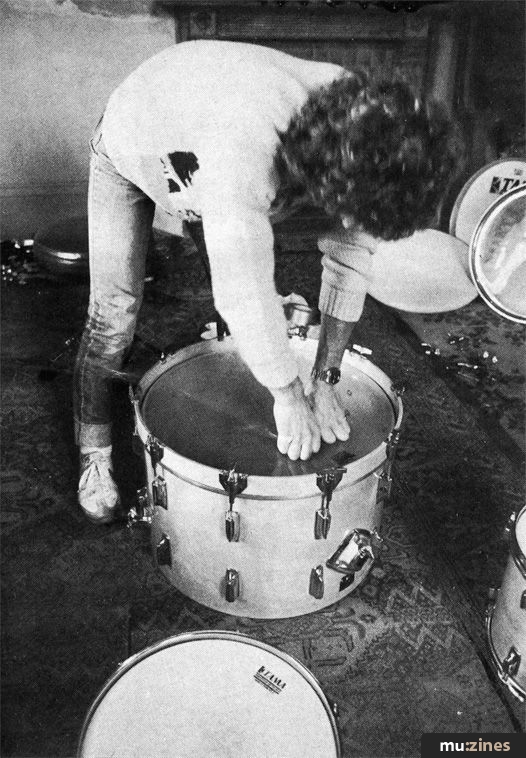
When the A-string of your guitar resonates at 440Hz you say by definition that it's in tune. For drummers things aren't so simple: no-one can tell you if your drum's in tune or not. If you like it, that's it.
Of course, this freedom brings its own problems. Most drummers seem to arrive at their own tuning routine after an agonising process of trial and error, and are continually on the look out for any idea that might improve on it.
So there are no accepted rules. And the nearest I can discover to a universal tuning method is something like the following. First, the head is put on the shell and the slack is taken up finger-tight all round. A new head is then best "seated" by pressing on the centre with the fist, or alternately over-tightening and slackening back off. The rods are then taken up a quarter or half turn at a time, either diagonally across the shell or circularly around the shell.
When you get close to the sound you're after you tap round the head a little way in from each tension rod, and listen carefully for variations in pitch. By painstakingly fine adjustment the aim is to get the same pitch all around the head, so that the head is "in tune with itself" — at which point the drum hopefully sounds clean, full and at its best.
The actual degree of tension applied is down to personal feel. But each drum has a certain range within which it can be said it sounds acceptable, and depending on your requirements you'll tension it somewhere — higher or lower — within this range. And generally it's automatic to tune each of the tom-toms (at least) in a similar way, and to a similar tension, so that the feel is consistent across the range. If this is done there's a good chance the kit will have a homogenous feel and balance.
Interestingly, most drummers, consciously or not, tune their drums to recognisable intervals, maybe to thirds or fourths for example, or to whatever sounds pleasing. For recording a particular song you might try to "tune" the drums to a specific key (I've read, for example, of Billy Cobham doing this). But because drum sounds have numerous overtones, the kit will usually blend into whatever key the band's playing in. Just occasionally a drum (or cymbal) will appear to be discordant and jar. In such cases there's no option but to retune the drum or change the cymbal.
The other complication which makes drum tuning so variable and tricky is that of double-headed drums, where both heads have to sound right. You can have the bottom head higher, or lower, or at the same pitch as the top head, and each of these three possibilities is favoured by different drummers. You might require a taut top head for stick response, with a slacker bottom head for depth; or viceversa for top-head punch with the bottom bringing up the pitch. You might also argue for both heads being the same, so that the whole drum is again, "in tune with itself".
The snare drum is a special case. The bottom head is so thin and resonant it sounds very high after just a few turns. Obviously this is to get the maximum response from the wire snares, which themselves must be evenly tensioned. The tension of the batter head will depend on whether you want a sharp "military" crack or a sleazier, funky slap, or somewhere between. The variations are huge, and luckily I don't have room to say more...
The drum shell is a stable resonating chamber; the actual sound source is the head, and the type of head used affects the sound almost as much as the tuning. CS (controlled sound) black dots are good allround rock heads. They're of medium weight and are responsive, but the black dot centre-reinforcement slightly dampens the beat. One stage further, "pinstripes" are a double-laminate. So they're more dampened, but have a very punchy, funky sound. Both these heads have been popular over recent years, but as livelier drum sounds are returning, the traditional white-coated, medium-weight heads are making a bit of a comeback.
Plain heads are also common now in transparent material, and these are often used top and bottom, or beneath (usually transparent) CSs or pinstripes. White-coated Ambassadors or Diplomats (different thicknesses of head) have always maintained their popularity as snare batters for their clarity and crispness. Other specialised heads include Fiberskyns, which attempt to emulate the mellow sound of calf skin, and Evans oil-filled hydraulic heads, which are extremely heavy-wearing. These latter require hard playing, but have a unique and very controlled sound.
The permutations of heads and tuning methods are therefore limitless, and I'm sure there are as many techniques for tuning as there are drummers. Just to emphasise this point, many drummers, having evenly tuned a drum, will tighten or slacken a particular rod for a particular effect or to cut out a certain ringing or other interference.
And I have to say I've heard more than one famous and respected drummer maintain that he doesn't follow any ordered method — simply turning the rods until the drum "feels" right. Evenly tensioned or not...
Series - "Real Drum Special"
Read the next part in this series:

Drummers Drumming (Part 5)
(12T Apr 85)
All parts in this series:
Part 1 | Part 2 | Part 3 | Part 4 (Viewing) | Part 5 | Part 6 | Part 7 | Part 8
More with this topic
 Zen Guitar |
 Chord of the Month - Keyboards |
 Chord of the Month - Keyboards |
 Chord of the Month - Keyboards |
 Drum Hum |
 Lungs And Tongues |
 Fender Fretless Precision - Fretless Bass Playing |
 Vocal Infection - Voice Training |
 Drum Hum |
 Beat Box |
 Skill Centre: It Bites - It Bites Play "Calling All The Heroes." |
 Chord |
Browse by Topic:
Tuition / Technique
Publisher: One Two Testing - IPC Magazines Ltd, Northern & Shell Ltd.
The current copyright owner/s of this content may differ from the originally published copyright notice.
More details on copyright ownership...

One Two Testing - Mar 1985
Donated by: Colin Potter
Real Drum Special - Part 1
Topic:
Tuition / Technique
Series:
Real Drum Special
Part 1 | Part 2 | Part 3 | Part 4 (Viewing) | Part 5 | Part 6 | Part 7 | Part 8
Feature by Geoff Nicholls
Help Support The Things You Love
mu:zines is the result of thousands of hours of effort, and will require many thousands more going forward to reach our goals of getting all this content online.
If you value this resource, you can support this project - it really helps!
Donations for May 2026
Issues donated this month: 0
New issues that have been donated or scanned for us this month.
Funds donated this month: £0.00
All donations and support are gratefully appreciated - thank you.
Magazines Needed - Can You Help?
Do you have any of these magazine issues?
If so, and you can donate, lend or scan them to help complete our archive, please get in touch via the Contribute page - thanks!
Please Contribute to mu:zines by supplying magazines, scanning or donating funds. Thanks!
Monetary donations go towards site running costs, and the occasional coffee for me if there's anything left over!

 @mu_zines
 RSS Feed
 Blog
Blog