


Magazine Archive
Home -> Magazines -> Issues -> Articles in this issue -> View
IBC Review | |
Brighton England: Sept 1986Article from Sound Engineer and Producer, November 1986 | |
Latest news from Brighton's annual broadcast showcase IBC

Synclavier direct-to-disk system
"The end of tape is nigh": so stated a placard carried around sandwichboard fashion outside the Brighton Metropole by a hireling of Synclavier! It seems that they perhaps are not the only ones with this opinion, with a number of manufacturers at the show indicating more than a passing association with the idea of the tapeless studio: Synclavier's interest being in its direct-to-disk multi track recording system.
For a broadcast show, it is most interesting to note the strong presence of "high quality" audio associated with video, either in combined products, or in system configurations, demonstrating the commitment of the video industry to the improvement of audio's role. To quote a few initial examples, Panasonic, with an interesting new commitment to broadcast video, was showing an M2 format component video cassette recorder (its contender for the market so far dominated by Betacam) which incorporates two FM sound tracks along with the picture, in much the same way as the domestic VHS and Beta hi-fi recorders do. It also proposes an industrial VHS machine with the same facility.
Sony has SP Betacam (a "super" Betacam) which also incorporates stereo FM sound, and was showing the BVH 2800 series C-format video machines which carry two channels of 16-bit linear digital audio along with the picture. All these developments will be music to the ears of those video duplication companies and facilities houses who have been waiting and searching for some means of putting high quality stereo sound on videos, especially now that the BBC is actively pursuing the notion of digital stereo TV sound transmitted in the TV signal, and that satellite TV broadcasts could in future contain digital stereo sound.
Neve was pulling out the stops, in association with the BBC, to show the DSP equipped "digital sound control vehicle" in all its glory, by sending up to 16-channels of digital audio back and forth down a fibre-optic cable linking Neve's stand on the gallery in the Metropole with the vehicle on the sea-front outside, and also with the BBC Engineering stand downstairs. This was primarily to demonstrate how the digital audio convertors could be remotely located in an outside broadcast, to feed back a large amount of digitized audio to the sound control centre on very little cable. In the demo at IBC, the output of the DSP was being recorded direct, with no analog conversion, onto a Sony PCM 3324.
On the synchroniser front, Adams-Smith has broken new ground with a two machine chase synchroniser that also incorporates MIDI sync facilities.
The "Zeta Three" has two wideband timecode readers, software configurable machine interfaces, and the ability to take MIDI IN/OUT/THRU and synchronise the song pointers to timecode. Although each part of this is nothing new, this is the first time that machine control and synchronising has been joined up in one box with MIDI sync as well: at an estimated sale price of £2,500 one begins to appreciate its claim that they eclipse the competition! The company also demonstrated a "compact controller" for the 2600 synchroniser, which stores cue points, rehearses edits, addresses up to five slaves and generally enhances the operation of the system.
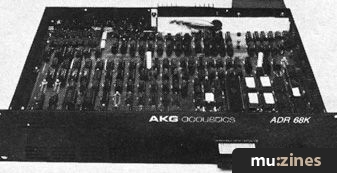
AKG ADR 68K
AKG's innovative digital effects and reverb unit the ADR 68K "saleable" stage, and provides a number of digital reverb programs as standard, plus the facility for the user to program some himself using sliders for data entry (a very useful method, and a bit like the DX7 data entry slider). Programs can be stored on RAM carts, and they may implement a system exclusive MIDI data dump in future software editions (which I understand will be free to existing customers).
Presently it is not possible to use the MIDI interface of this unit to control pitch change of stored samples, but this is also intended for future software. AKG mention a suggested selling price of around £5,000, although this is not finalised.
AMS indicated to me that the AudioFile will very soon be equipped to cope better with digital editing, in that they are providing the facility to use a search wheel for fine-trim of the edit point while hearing audio around the rough point.
Unlike existing digital editors from other manufacturers, the AudioFile will give full bandwidth, full resolution stereo sound in this mode, rather than the rather distorted telephone-like sounds one is used to.
On a similar subject, Lexicon gave the first inkling of a product which it hopes to release at the AES in Los Angeles: it's called the Opus, and seems to be a cross between the AMS AudioFile and the Lucasfilm Sound-Droid, both in cost and features. The photograph that they were showing indicated that the product looks very much like a mixing console, with an editing section and a VDU, and I was told that a basic system could handle 12 audio channels to be routed to and from a hard disk recorder, giving one hour of monaural recording, expandable up to eight hours with more disk capacity. Conceptually, the system is an integrated audio editor and mixing system with digital recording, to be aimed at the sound dubbing market, where flexible editing and repositioning of sounds is a regular requirement. Watch this space closely!
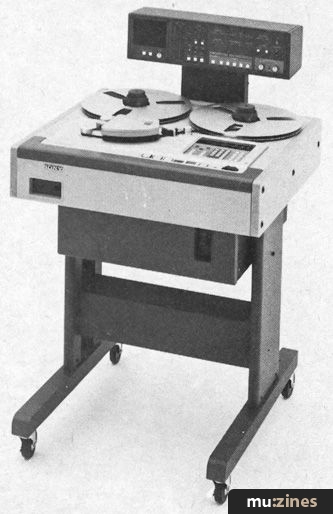
Sony PCM-3402
At the IBC show, the DASH format (stationary head digital audio recording) gained a new lease of credibility with Sony's launch of a switchable speed machine, the PCM 3402, made in Japan, as opposed to the previous attempts from Florida. In style it more closely resembles Studer's D820X high-speed only DASH machine, with wider deck plate and wooden ends, and a wealth of features are standard. The machine has built-in electronic editing, so that two of them could be connected together in an editing pair, like video machines, eliminating the need for an additional editor like the DAE 1100. The PCM 3402 will lock to a video reference and to external timecode, using a built-in synchroniser, and acts just like an analog machine in that tapes recorded at the lower speed (7.5ips) will sound at double speed when accidentally replayed at the higher speed (15ips).
The only drawback is an anticipated delivery date of June 1987, but the anticipated price of around £20,000 is competitive with Studer's single-speed machine (whose price has recently escalated due to the strength of the Swiss Franc). Studer anticipate that it will deliver within the next few months.
The impression that I have gained from this show with regard to R-DAT and DASH (no R-DAT machines were shown) is that the first thing we are likely to see on the R-DAT front is a portable professional machine (an R-DAT Nagra if you like), which Sony hope to show in Los Angeles, while the DASH studio machines and the PCM-1630 will form the mainstay of studio recording.
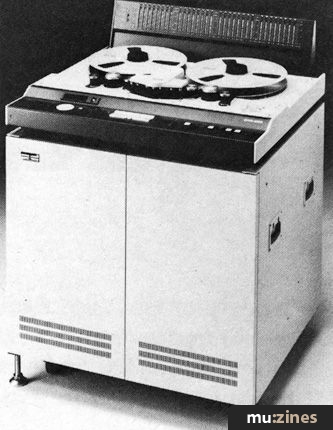
Otari DTR 900
Otari brought a DTR-900 multi track PD recorder, which costs a little more than Mitsubishi's counterpart, but offers some other essential features like a multichannel meter bridge and balanced line outputs: it also seems a little quieter on the fan-noise front than the X-850, which can only be a good thing.
Back with hard-disk digital audio, a Japanese company who so far has concentrated on video, called For-A, showed the Sirius 100 which is capable of storing a maximum of 1000 minutes of monophonic audio when equipped with the maximum number of drives. It's more suited to radio sound editing, sound effects, and that sort of thing at the moment, but has tremendous potential for pro audio if only a few things were changed. For example, up to eight users can be on-line from separate controllers at once, with a realtime monophonic output for each of them, or four users in stereo, but the sampling rate is a quirky 33.6kHz, and the controllers that are provided now do not allow fine search of edit points or any time code locking facilities, neither do they make simultaneous eight track recording viable. They are quoting a ball park price of £20,000, though, for 40 minutes of mono (twenty of stereo), makes the package seem attractive.
Synclavier's Direct-to-Disk recording system is very impressive, using one drive per channel, making overdub operations very flexible. The sampling rate can be varied from very little right up to 100kHz, and it says that this system is better suited to studio-type music recording than something like the AudioFile, which would not allow replay of one track while another is recorded. One would have to find these advantages very attractive to justify the asking price of $253,000 for 13 minutes of 16 tracks, although there are the benefits of incorporation with the Synclavier music system products.
In Conclusion it seems worth making the point that if this year's IBC is anything to go by, the worlds of audio, video and computers aren't going to be separable for much longer.
Publisher: Sound Engineer and Producer - Media Week Ltd.
The current copyright owner/s of this content may differ from the originally published copyright notice.
More details on copyright ownership...

Sound Engineer and Producer - Nov 1986
Donated by: James Perrett
Show Report by Francis Rumsey
Help Support The Things You Love
mu:zines is the result of thousands of hours of effort, and will require many thousands more going forward to reach our goals of getting all this content online.
If you value this resource, you can support this project - it really helps!
Donations for August 2026
Issues donated this month: 0
New issues that have been donated or scanned for us this month.
Funds donated this month: £0.00
All donations and support are gratefully appreciated - thank you.
Magazines Needed - Can You Help?
Do you have any of these magazine issues?
If so, and you can donate, lend or scan them to help complete our archive, please get in touch via the Contribute page - thanks!
If you're enjoying the site, please consider supporting me to help build this archive...
...with a one time Donation, or a recurring Donation of just £2 a month. It really helps - thank you!

 @mu_zines
 RSS Feed
 Blog
Blog