Mr Versatility (Peter Collins)
(EMM Oct 86)


Magazine Archive
Home -> Magazines -> Issues -> Articles in this issue -> View
Tracks | |
Detailed track by track analysis of top albums and singles | Peter Collins, Gary MooreArticle from Sound Engineer and Producer, November 1986 | |
Producer and engineer explain their methods of recording the music of Gary Moore
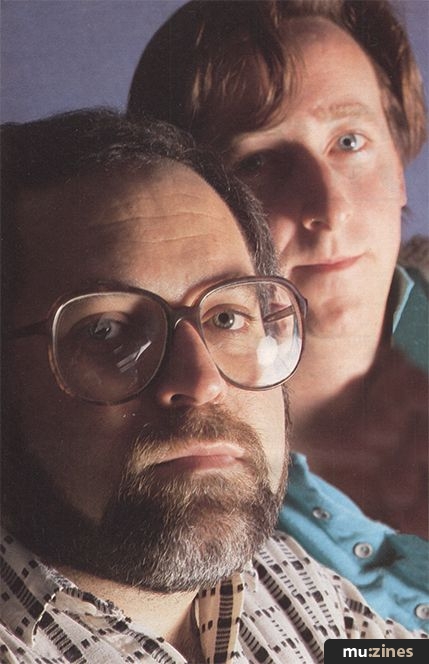
Peter Collins (foreground) Jim Barton (back): a seasoned and successful partnership
Image credit: Barry Marsden
TRACK: Wild Frontier
ARTIST: Gary Moore
LABEL: Virgin 10
STUDIOS: Master Rock, Sarm East, Sarm West
PRODUCER: Peter Collins
ENGINEERS: Jim Barton, Chris Porter
PETER COLLINS started out in the music business as a singer/songwriter, and in the early Seventies he acquired a record deal with Decca courtesy of his uncle, Russ Ballard, who was managing Argent.
After recording an album, however, he chose production as his vocation, and gained employment as a "studio assistant" at Decca.
Whilst learning his craft and putting together some of his own productions, Collins earned money writing jingles, and in 1979 was producing on a freelance basis for Magnet records gained his first major breakthrough with rockabilly band Matchbox.
This was followed by a fruitful collaboration with Pete Waterman, producing at Rocket Records and subsequently MCA — prior to the two men going their separate ways.
Amongst those to have been successfully produced by Pete Collins are Alvin Stardust, The Lambrettas, The Belle Stars, Musical Youth, Nik Kershaw, Tracey Ullman and Matt Bianco.
JIM BARTON cut his musical teeth as a struggling musician in a band trying to earn a living in his native Australia.
He became — in his own words — "mesmerised" by the studio and its workings when he started an album with the group. He soon decided that this was where he wanted to be. As a result, at the age of 17 he was working as a tape-op at Armstrong studios in Melbourne, gaining invaluable musical experience with the local groups.
Eventually, after earning himself a solid reputation through his engineering on records by artists such as Men at Work and Julian Mendelsohn, he arrived in England after Mendelsohn had recommended his studio skills to Peter Collins. Since then, the producer-engineer team of Collins and Barton has enjoyed success with Blancmage, Rush, Billy Squire, Phil Lynott and Gary Moore amongst others.
Peter Collins: 'I was working in New York when Gary's manager Steve Barnett contacted me and said "Gary's writing a song called Wild Frontier", which I though sounded like a great title. I came back, and Gary had done a demo, of which I thought the intro, verse and chorus were really good. He had done it at home with his drum machine, some basic synths and a lead vocal.
'I really liked it, but the only thing was that the mood of the chorus seemed too poppy for the rest of the song. I played it to Jim at Sarm East; it had some great ideas to it, but I thought that the chorus just needed a little more substance to it, a little more meat.
'I spoke to Gary about it and he understood, and he changed it around a little bit and gave it a bit more "attitude" to make it more consistent with the feeling of the rest of the song.
'He then rehearsed it with his band and sent me over a rehearsal demo. This achieved what I wanted in the chorus, and we agreed just to get on and do it.
'The next stage was at John Henry's London rehearsal complex with Gary's band, and rehearsing it. Gary had tried it out on stage on quite a few occasions and felt very good about it; it had worked quite well and the audience were into it. The only major objection that I had was that he had a breakdown chorus towards the end — a handclapping type item — that worked great live, which I thought was a bit too trivial for the record in terms of what it was trying to put across.
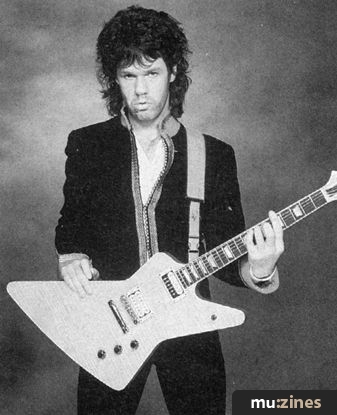
Gary Moore
'We always rehearse the material live with Gary, to see how it works with the band. You'll never know what little ideas can get thrown up... although that's an unfortunate way of putting it!
'Gary always has a band that can play, and that is usually fairly sensible without everyone being on huge ego trips. It's a controllable situation where you can just examine sections of songs, without somebody blasting away with a guitar all of the time whilst you are trying to talk, or a dummer thrashing around trying to make himself recognised as a star player or whatever. Young bands, in a rehearsal, sometimes are all geared up to try and impress you, and are not really listening.'
Jim Barton: 'Also Gary, unlike many other bands, places a lot of emphasis on his live performances. Because his band is good at playing it means a lot to him. He'll be the first to say sometimes that the arrangement on a record might not suit the track live but that it'll be nothing for him to change it for concert performances.'
PC: 'So we sorted out what we were going to do: We changed the breakdown chorus for a kind of semi-spoken section of the song which ended up as a tribute to Phil (Lynott). There were very obvious Thin Lizzy aspects to the song, and so it was a natural process to dedicate it to him.
'Jimbo was on honeymoon at the time. We wanted a studio bigger than Sarm East to do the drums, and so we went to Master Rock in Kilburn and got the basic stuff laid down; the SMPTE code, SRC start time, all that stuff. We had a Linn track pre-programmed as a guide to work to, and we put down some keyboards, some guide vocals, a lot of which were used. All of this was done on an SSL desk.
'We did the drums a number of times, but our first crack at them was at Master Rock! We wanted to give a bit of air to the sound...'
JB: 'More ambience. It doesn't necessarily follow that a big studio is going to give you that, but I would think the chances are more in your favour.'

Original track sheet for Wild Frontier
(Click image for higher resolution version)
PC: 'Jimbo can create a big drum sound no matter what it is, no matter where it's recorded! So we went for it at Master Rock, but we only had one day booked there and didn't get it quite sounding right. So we used it as a working program, and did our overdubs to the Linn with a view to replacing them with the real kit at a later time.
'We then headed back to Sarm East to work on it. Andy Richards came in and we tried Fairlight drums, but they didn't quite have the feel that we wanted. It's quite a tricky drum fill on this record, and eventually Rolly came in and we did the final drums at Sarm East.'
JB: 'We got ambience from odds and sods of samples that we have. It's a combination of several elements that create a final melange!'
PC: 'Jimbo didn't do all of this record; he mixed it and did some overdubs, and Chris Porter did the rest.
'Guitar wise we decided to make them in a Thin Lizzy mould if we could. Hence in the solo this little reference to Whisky In The Jar, and the guitar sound that Gary got had this fiddle type quality on the main theme. There are some other Lizzy references, such as the ad-lib that he does on the end, but we didn't want to get too heavily into that. It felt good. It is also very, very rare that Gary does a harmony part to a lead line — that's one of the things that he's tried to avoid — but in this particular instance he did it for the Lizzy reference, and it works very well with the theme.
'We used a couple of guys on backup vocals — Don Snow and Paul Muggleton — and we used real strings for certain sections of the song.'
JB: 'It was just a matter of sorting ideas in the end. There was quite a bit of stuff on the slaves, and it was just a case of deciding what was good and what wasn't, and compiling it back onto one master reel.'
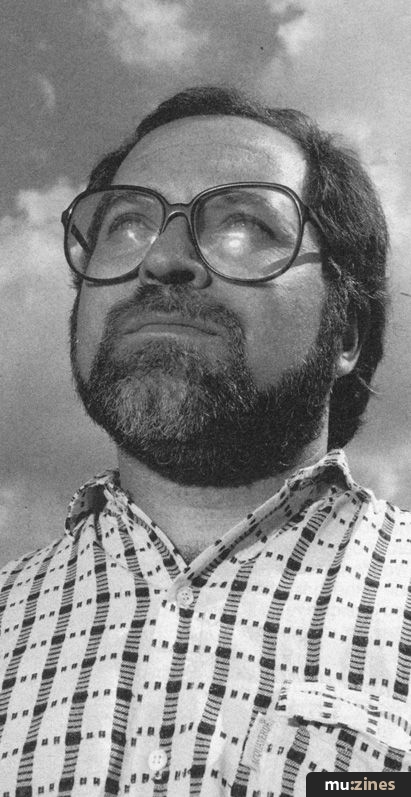
Image credit: Barry Marsden
PC: 'We use slave reels as sketch pads, so if there's a number of backing vocal ideas we'll whack them all down, and when it comes to getting the arrangement sorted out before we mix we get everything back to the 24 track master and edit the ideas at that stage.'
JB: 'We always work 24 track, simply because neither of us have the patience! If the arrangement is good and it is right, and everything else including the performances are alright, I personally feel that you don't need to build a huge headache for yourself at mixing time. Forty eight track is a great work tool while you're doing it for sketching, but pointless for mixing.
'Everything went very smoothly. It took us about 12 hours to mix the track in Studio 3 at Sarm West, and there were no real major changes to be made.'
PC: 'Jimbo just vibed the whole thing up and made it really exciting, He did a great mix — which is to be expected!'
JB: 'I thought for that one we might have to remix. I knew it was going to be quite a tricky mix, there was quite a lot going on, and although there was quite a lot of arrangement detail it had to sound uncomplicated.
'In terms of effects, generally what we do is when it comes time to compile and edit all the ideas and put them back onto 24 track we add a lot of effects then. In that way I'm not tying up outboard gear for the mix, and hopefully in the mix a minimum of equipment is needed; the obligatory vocal reverbs making sure that the vocal is the right mood for that particular section, changing it for the next section, and so forth.
'For the mix on this track we used an AMS reverb, a Lexicon 224, a Lexicon 224X, an AMS delay for a very small repeat thing on the vocal, a very tight digital delay in the verses, a long plate just to open the vocal out on the chorus, short gated plates on the drums, hi-hats and cymbals for a bit more impact, a bit of compression over the general mix and that's about all...'
PC: 'Sounds easy!'
JB: 'With the guitars, Gary's such a fine player that it's difficult to ever mix his guitars back. He's an absolute master in his field, probably the best guitar player I've ever worked with. Unbelievable, a real virtuoso. Plus Gary's sound, it'll cut in any track, there's never any problem. His part, his sound, is always perfect.'
PC: 'We let him do four of five takes on a slave reel, and then just chose the one we liked best. Obviously, whether we want it to have rough edges or not depends on the particular track — a soft ballad like Empty Rooms requires a more lyrical quality, for example — but on this track there are a few little cracks and popples, and a bit of crap in there as well! A bit of stark reality!'
More from these artists
 |
 Gary Moore (Gary Moore) |
 So You Say - Gary Moore (Gary Moore) |
 Gary Moore (Gary Moore) |
 Moore's Code (Gary Moore) |
More from related artists
 Innovators (Nik Kershaw) |
 Nik Kershaw: Recording Secrets (Nik Kershaw) |
 Nik Picking (Nik Kershaw) |
 The Man Who Would Be Both (Nik Kershaw) |
 |
 Radio Active (Nik Kershaw) |
More with this topic
 Feed The Tape - Band Aid |
 Track Record: Rain or Shine |
 Track Record: Lean On Me |
 Track Record: Come On Home |
 Tracks - Detailed track by track analysis of top albums and singles |
 Track Record - Kayleigh |
 Track Record - Tomb of Memories |
 Tracks - A producer's guide to top albums and singles |
 Track Record: Lessons In Love |
 Tracks - A producer's breakdown of top albums and singles |
 Bill Price - Jesus and Mary Chain - Darklands |
 Tracks - Marillion - Kerouac |
Browse by Topic:
Classic Tracks
Publisher: Sound Engineer and Producer - Media Week Ltd.
The current copyright owner/s of this content may differ from the originally published copyright notice.
More details on copyright ownership...

Sound Engineer and Producer - Nov 1986
Donated by: James Perrett
Feature by Richard Buskin
Help Support The Things You Love
mu:zines is the result of thousands of hours of effort, and will require many thousands more going forward to reach our goals of getting all this content online.
If you value this resource, you can support this project - it really helps!
Donations for August 2026
Issues donated this month: 0
New issues that have been donated or scanned for us this month.
Funds donated this month: £0.00
All donations and support are gratefully appreciated - thank you.
Magazines Needed - Can You Help?
Do you have any of these magazine issues?
If so, and you can donate, lend or scan them to help complete our archive, please get in touch via the Contribute page - thanks!
Please Contribute to mu:zines by supplying magazines, scanning or donating funds. Thanks!
Monetary donations go towards site running costs, and the occasional coffee for me if there's anything left over!

 @mu_zines
 RSS Feed
 Blog
Blog