


Magazine Archive
Home -> Magazines -> Issues -> Articles in this issue -> View
Project Blocks | |
Article from Electronic Soundmaker & Computer Music, February 1984 | |
Our mixer dissected
Figure 1 is a block diagram of a four input version of the Mixer. A signal connected to one of the input channels first passes to a buffer amplifier stage. The buffer amplifier has a high impedance input to match the signal source. Its output impedance is very low so that it can drive the next stage without distortion. Another function built into the buffer amplifier is an input gain control. This control allows the channel's contribution to the final output mix to be varied smoothly from zero to maximum.
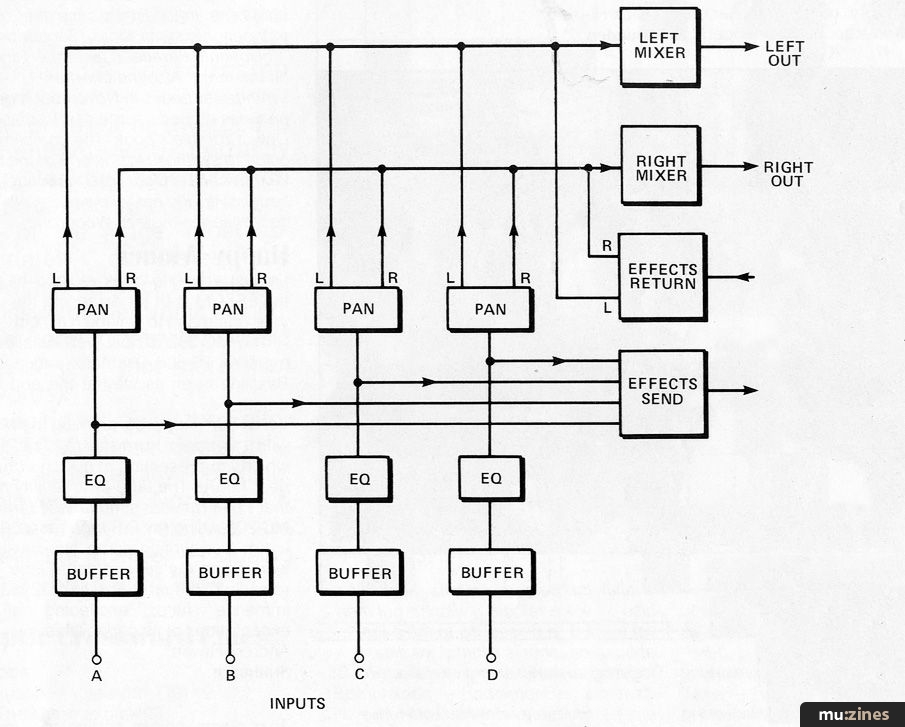
Fig 1 Block diagram of a 4-input mixer.
Following the buffer amplifier in each channel is an equalization stage. The circuit used here is a parametric equalizer. This allows the frequency response of the channel to be tailored by the insertion of a single peak or dip in the gain of the channel anywhere in the audio band. Two equalization controls are provided, one sets the centre frequency, the other sets the degree of peak or dip present. See Fig. 2.
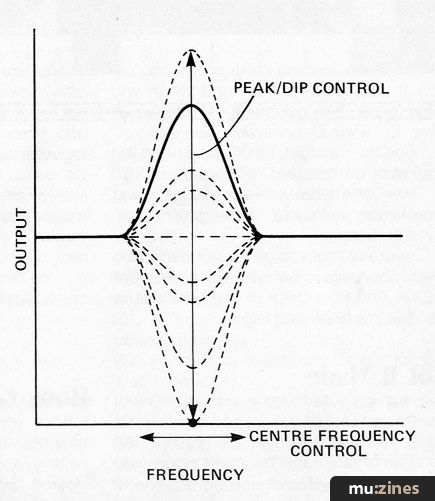
Fig 2 Frequency shaping via the equalisation network.
After equalization the signal is passed to the mixer amplifiers via a pan pot. The pan pot operates in the same way as the more familiar balance control found in most stereo amplifiers. It allows the signal to be distributed between the two output channels. Use of the four pan pots allows each channel to be positioned anywhere in the stereo image of the output.
An additional control on each input channel allows some of the signal to be sent to a third output mixer amplifier, the 'effects send' amplifier. All three output mixer amplifiers operate in the same way. Each receives four signals, one from each input channel. These inputs are added together or mixed to produce a single low impedance output. The outputs from the two main mixer amplifiers drive the output sockets via individual output channel level controls.
The final block is the 'effects return' amplifier. This acts as a very simple input channel, consisting of a buffer amplifier and a pan pot. It receives its input from an external effects unit (if one is being used) and drives the two main mixer amplifiers. The pan pot allows the 'effects' signal to be mixed between the two main output channels.
More with this topic
 Guitar Routing Box (Part 1) |
 Amdek DMK-200 Delay Machine Kit |
 Studio Earthing Techniques - Interconnect (Part 1) |
 BeeBMIDI (Part 1) |
 On the Level |
 The Syndrom - How it Works (Part 1) |
 Interfacing External Signals with the Gnome Micro-Synthesizer - Guitar/Gnome Interface |
 How To Make An EGG Mod |
 The Layman's Guide to Digital Logic Gates - (in one easy lesson) |
 Technically Speaking |
 Lab Notes: Computer Music Without the Computer - or: What to do 'til your processor arrives. |
 Adding Fine Tuning To Standard Controls |
Browse by Topic:
Electronics / Build
Publisher: Electronic Soundmaker & Computer Music - Cover Publications Ltd, Northern & Shell Ltd.
The current copyright owner/s of this content may differ from the originally published copyright notice.
More details on copyright ownership...

Electronic Soundmaker - Feb 1984
Donated by: Ian Sanderson
Feature
Help Support The Things You Love
mu:zines is the result of thousands of hours of effort, and will require many thousands more going forward to reach our goals of getting all this content online.
If you value this resource, you can support this project - it really helps!
Donations for June 2026
Issues donated this month: 0
New issues that have been donated or scanned for us this month.
Funds donated this month: £0.00
All donations and support are gratefully appreciated - thank you.
Magazines Needed - Can You Help?
Do you have any of these magazine issues?
If so, and you can donate, lend or scan them to help complete our archive, please get in touch via the Contribute page - thanks!
If you're enjoying the site, please consider supporting me to help build this archive...
...with a one time Donation, or a recurring Donation of just £2 a month. It really helps - thank you!

 @mu_zines
 RSS Feed
 Blog
Blog