Return of the Big Synth - Roland JX10 Polysynth
(EMM Jun 86)


Magazine Archive
Home -> Magazines -> Issues -> Articles in this issue -> View
Article Group: | |
Roland JX-10 | |
Article from One Two Testing, July/August 1986 | |

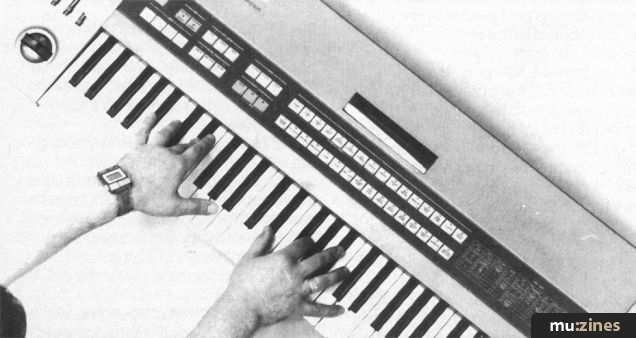
It's about time that Roland had a new top-of-the-month synth, and you won't find any conventional keyboard more powerful than this twelve-voice analog synth with programmable split and a stack of unusual performance features.
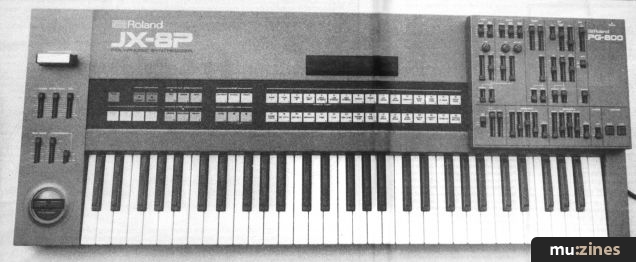
The JX-10's individual voice is identical to the JX-8P's with two oscillators, two envelope generators and one filter per voice plus white noise. You can layer or split two six-note polyphonic sounds and there are four audio outputs so you can record both sounds (under the control of two different MIDI channels if you like) with stereo chorus.
A six-and-a-half octave semi-weighted velocity and pressure sensitive keyboard makes the JX-10 a good bet as a mother keyboard; you can control Volume and Brilliance with velocity, and Cross-Fade in Dual Mode. There are 64 Patch memories which store one or two sounds, a split point, the keyboard mode and all the performance settings such as pitch bend depth; you have 64 presets and 64 programmable sounds to choose from, with more on an M64C cartridge.
The very weird Chase Play facility records up to 32 notes for between ten milliseconds and three seconds, then repeats them with programmable Level, Dynamics Time Follow and Keyboard Mode (Lower, Upper or Upper/Lower Alternation). Chase Play allows Dual Mode sounds to be echoed by the synth with the same sound or with a different sound, so the JX-10 can make like it has a built-in digital delay, ADT or "cascade generator".
There's a built-in realtime sequencer (650 steps on the M16C cartridge provided, 2,600 on an M64C cartridge) with Single and Loop Play functions, Overdub and Punch In and internal or external MIDI clock.
As on the Alpha Juno 1 and 2 and the MC500 MicroComposer, the JX-10 has an Alpha Dial for access to and editing of all its parameters.
A nice big illuminated 32-character LCD allows you to name programs and shows the current keyboard mode and parameter values. Options; a DP-2 footswitch starts and stops the sequencer, shifts patches or switches Portamento and Hold on and off, and an EV-5 pedal controls volume, portamento time and sequencer speed. There's even a stereo headphone socket.
The JX-10 sounds fat and powerful and its keyboard action is good. But at around £1,500 it's going to have a hard time competing with the Prophet VS, Oberheim Matrix 6, Ensoniq Synthesizer/Sequencer and even Roland's own velocity and pressure-sensitive Alpha Juno.
Roland UK, (Contact Details)
Also featuring gear in this article


Roland JX-10 - SynthCheck
(IM Jun 86)

Super JX
(SOS Jun 86)

Patchwork
(MT Jun 92)
Browse category: Synthesizer > Roland
Featuring related gear
JX-8P: A Player's Guide
(IM Jun 85)

Roland JX8P - Synthcheck
(IM Mar 85)

Roland JX8P
(12T Mar 85)
Roland JX8P
(IT Jun 85)


Sense & Sensitivity - The JX-8P
(IM Feb 85)

Showstopper
(IM Apr 85)


The Innovator - Roland JX8P
(ES Mar 85)

The JX-8P - Creative Synthesis Lives!
(IM Mar 85)

Patchwork
(MT Nov 86)

Patchwork
(MT Mar 87)
...and 1 more Patchwork articles... (Show these)

Program Notes
(MM Jul 86)

Program Notes
(MM Oct 87)
Browse category: Synthesizer > Roland
Publisher: One Two Testing - IPC Magazines Ltd, Northern & Shell Ltd.
The current copyright owner/s of this content may differ from the originally published copyright notice.
More details on copyright ownership...

One Two Testing - Jul/Aug 1986
Mini Reviews
Review by MJ
Ads for Gear in this article:


Help Support The Things You Love
mu:zines is the result of thousands of hours of effort, and will require many thousands more going forward to reach our goals of getting all this content online.
If you value this resource, you can support this project - it really helps!
Donations for August 2026
Issues donated this month: 0
New issues that have been donated or scanned for us this month.
Funds donated this month: £0.00
All donations and support are gratefully appreciated - thank you.
Magazines Needed - Can You Help?
Do you have any of these magazine issues?
If so, and you can donate, lend or scan them to help complete our archive, please get in touch via the Contribute page - thanks!
Please Contribute to mu:zines by supplying magazines, scanning or donating funds. Thanks!
Monetary donations go towards site running costs, and the occasional coffee for me if there's anything left over!

 @mu_zines
 RSS Feed
 Blog
Blog