


Magazine Archive
Home -> Magazines -> Issues -> Articles in this issue -> View
Soul Searching | |
Soul II SoulArticle from Music Technology, June 1989 | |
From a clothes and record shop to an electronics company to a sound system to an excellent album and charting single, London's Funki Dreds are on the move. Tim Goodyer talks tech to Soul II Soul's Jazzie B.
Anyone with their ear to the radio and their eye on the music press will have heard Soul If Soul's 'Keep On Movin" and read about clothes shops, funki dreds and sound systems. But who or what is behind Soul II Soul?
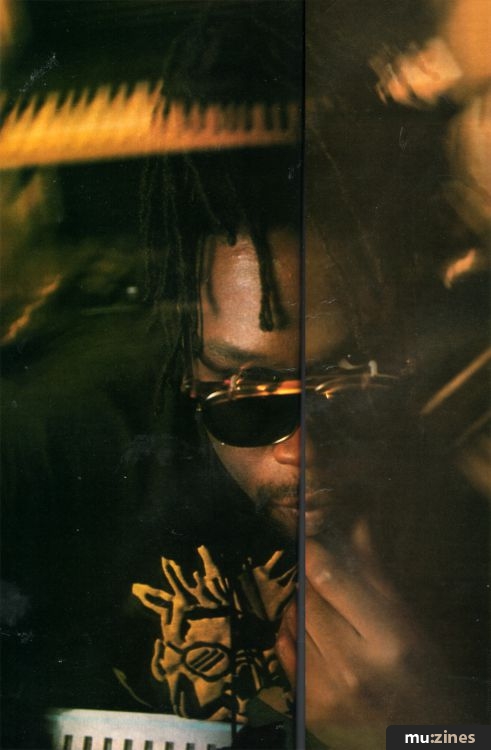
A UNIQUE MOOD accompanies every interview with a musician. It might be one of respect, perhaps for an artist whose music has influenced you strongly. It might be one of excitement, as surrounds a band experiencing success for the fiirst time. It might be one of apprehension, for a wide variety of reasons...
Music Technology's encounter with Soul II Soul took place almost too late to appear in the magazine you have in your hands now. In the weeks that preceded my meeting with Soul II Soul's Jazzie B, the strains of their single 'Keep On Movin" pursued me with unnerving consistency. From radio play to party to demonstrations of studio mixing desks and monitors, Soul II Soul seemed to have discovered a formula that appeals to more than the nightclub DJ. As I am writing this, my CD player is counting off the seconds of Soul II Soul's LP debut, Club Classics Vol One.
As the interview took a while to come together, so did Soul II Soul themselves - establishing a clothes shop, an electronics company and sound system on their way to landing a contract with 10 Records and putting together what will certainly be a contender for Album of the Year '89. The story begins in the late '70s somewhere between Jazzie B's DJ'ing and his employment as a tape op at London's Nova studios. Here he gains a grounding in music technology and an appreciation of the creative side of recording.
"Engineering wasn't something I wanted to do", he explains at the Camden HQ of Soul II Soul, "it was a foot in the door to making my own records. I was always fascinated by sounds, how they work and what creates them. To be honest with you, I don't think I'd ever have made a great engineer because I didn't work how any of the others worked. I just didn't have the ability to be the kind of engineer that was told what to do and worked on the principle of a robot.
"Fusing my knowledge of the studio with my sound system was the common link in terms of me making music today. I guess I just held out until I was in the right place at the right time."
Another aspect of the Soul II Soul operation is the production company established between Jazzie B and Nellee Hooper, Silent Productions. Not only did the partnership play an essential part in the recording and production of Club Classics, but only a few minutes of conversation with Jazzie B reveals the importance of his partnership with Hooper.
"There's something about when we work together that's unique", he explains. "I think it's because a lot of the things we're frustrated about we can unleash together. We've worked totally on our own in places and come up with results, we've worked with different people and come up with results, and when we work together it's a combination of our experiences and our techniques that equals the production sound of Silent Productions."
Hooper also takes the credit for encouraging Jazzie B to take the step from DJ to recording artist. But it wasn't love at first sight.
"It was him that gave me the real push", he agrees. "Maybe I'm a bit more fronty than he is, he's real quiet. I can't remember the exact year we met but I can remember the encounter: it was a sound clash. The Wild Bunch came to London to DJ at a place where we were meant to be DJ'ing as well. We were blown out and everybody thought it was a little bit unfair and groups of people - I wouldn't say gangs or posses but groups of people, the way they are... bit of friction... But we discussed things and we said 'alright, we'll meet another time, another place'. And that's what happened and it was a good meet, you know? We got on together and when he came down to London to live he checked me out and we did things together."
LIKE SO MANY of today's generation of producers, Jazzie B's interest began with other people's music - first listening to it, then playing it as a DJ.
"DJ'ing is my first love" he admits. Eighty-nine will make 11 years I've been DJ'ing. My sound system's been running for seven of those years."
The evening after our conversation the Soul II Soul frontman is to play the first night of a residency the outfit have just secured at the Brixton Fridge. His understanding of music is to be proven when he has the audience dancing to an a cappella version of his new single 'Back to Life'. He puts this skill down to his knowledge of recorded music which he describes as "really, really deep across the board". Where many aspiring musicians would have invested their money in instruments, Jazzie B went for speaker cabinets.
"I used to have a little setup in my house a long time ago" he recalls, "and pulling down the kitchen ceiling with my bass bins was something I did through trying to make music, as it were."
Challenge him for details of the record decks and PA system that make up the present Soul II Soul sound system and you'll elicit a knowing smile and a polite refusal to "reveal all". You'll also uncover another aspect of Jazzie B's career.
"I worked for Court Acoustics for a little while. The secrets lie in the fact that we build all our own equipment. We load our own cabinets using certain firms and certain pieces of technology. My technician, Bruce Francis, built my first sound system and he still maintains this present sound system.
"I take my sound system very serious, more serious than anybody else could probably think of, that came before anything else. Nurturing it, understanding it, understanding how important the length of your cable from your amplifier to your speakers is, to your turntable, to the arm that's on the turntable, to the cartridge, to the needle that you use on the decks, to what kind of graphics with what kind of electronics are in there... Understanding that you start with the basics before you start EQing everything... I have to put all those things down to the technical guys making me understand things like that when I worked in studios. But there's some severe secrets that I obviously can't reveal 'cos that's Soul II Soul's secret."
One of the many strengths of Club Classics Vol One is the sound Jazzie B and Nellee Hooper have managed to get onto vinyl. In the recording studio the monitor speakers play as large a part in determining how the final record pressing will sound as any piece of hi-tech electronics. But studio monitors are supposed to have a flat frequency response - a far cry from the stacks of speakers of a PA system designed to move a dancefloor. Talking of his sound system Jazzie B sketches a history that takes in HH, Feng, Goodman, Celestion before coming up to date with the Wembley-based Pilot speakers. He talks about the preference for 12" bass drivers in rock circles and his own for 18" drivers ("I'm really really a mad bass-head, you know? I love good bass, good mid and good treble... "). He talks of the reluctance of the industry to make quality speaker systems a more affordable commodity. Of the importance of the PA system in a nightclub ("The breweries get into the decor, which is important, but the most important is the reproduction of sound and no one really deals with it...").
Then he talks with equal authority about his satisfaction with Yamaha NS10Ms as nearfield monitors, his liking for Quested monitors and his love for Westlake monitors. He talks about Tannoys and Meyers. But how do you successfully translate the sound of kiloWatts of bass to the studio environment?
"By using speakers you understand. The NS10s are pretty good for that. The whole thing about reproducing a sound is very personal anyway, and in a studio it's particularly difficult. The only way to interpret it is that each stage of mixing and production is different. Maybe when I'm eccentric enough or I've made enough money I'll have a setup where I'm monitoring through my PA. I think it really is that important."
But Jazzie B is eager to point out that the cutting of a record is as important as monitoring its recording.
"We've managed to cut exactly what we've got on our DATs or on the F1 so when we go into the cutting room there's no EQ. If there is any EQ it might be the failure of the monitoring at the studio.
"I've got a small fetish about how they do things in Japan. I've heard some stuff being cut out there that's really good. They've all the right elements: it's crisp, sharp, precise and very natural, something that's lacking in this country and America. The only thing I'd knock in this country is the cutting; I don't think there's enough people cutting dance music. The up and coming man is Chris at Music House and he cuts a lot of my acetates.
"But there's a lot of development time still to come in reproducing sound. Knowing what you like and understanding it, I believe, are two different things. I've studied the reproduction of sound and there are loads of different things which equal creating this type of sound, but if the human ear can only distinguish this, what's the point of creating that? It's very personal and I go more on the basis of what my sound system will deliver in volume as opposed to EQ. When you go into a club and they've got a really wak system, you tend to over-EQ and it's just like a lot of distortion. And again, it's only when you're playing a club that has two different systems one in one room and one in another - that you can distinguish that the crowd appreciate one more than the other. At the end of the day it's what the crowd appreciate, though to be honest with you, most of the crowd are probably deaf because they listen to their Sony Walkmans too loud!
"Soul II Soul are looking for sponsorship from a British company as opposed to an American or Japanese company because I really do believe the British build the best speakers."
GETTING BACK TO the music itself, Soul II Soul do justice to their name in the soul influences they embrace. But strong elements of rock, reggae, hip hop, and jazz have gone into the songs on Club Classics.
"I've set out to use all the influences from all the records that I've bought over the years", Jazzie B explains, "all the different artists and producers. My idea is fusing them all together and making a real positive British sound which has the elements of the Americanos - because that's where the music initially came from - but still fusing various rock 'n' roll elements because that's probably what this country's most famous for.
"The groundwork I have done as a DJ has obviously helped. The music myself and other DJs were responsible for playing and breaking is evident in the music I'm creating now, and hopefully there'll be other people trying it too. But let's hope they don't try and jump on the bandwagon, I hope other producers will further the whole British scene because there needs to be more of us."
The subject of influence and imitation is another that is close to Jazzie B's heart.
"You can't be a narrow minded person and make music. I listen to a lot of music - from Big Bam Boo to Augustus Pablo. I don't think I end up copying note-for-note anyone's material because I'm not that narrow minded."
He turns to face the cassette recorder recording our conversation as if to address those who are to read this interview personally.
"Yes, all those people who say 'but it's this', 'but it's that', - you try it. It's not as easy as it appears to be. For you to make something unique out of something everybody knows is not an easy task at all.
"The music in the charts governs the whole music thing in this country - maybe there should be a vetting procedure on who buys equipment."
"But I think narrow minded people will copy other peoples' music, especially with the aid of the technology, especially with a sampler. Certain things I hear people make tunes out of... It's disgusting. If something is yours, man, you must deal with it properly - don't bullshit the public. Sometimes I feel I've been conned when I buy certain peoples' material. You hear music in the charts, right, and half of that governs the whole music thing in this country. Maybe there should be some kind of vetting procedure on who buys what equipment and is allowed to use it."
Jazzie B is happy that his influences are sufficiently diverse to remain influences and absolve him from any allegations of stealing.
"When you're talking about writing new material and new lyrics and still holding all the influences of the greater people before, that's where the difference between us and a lot of other people lies. I haven't done a cover version vet. I've used various breaks of obvious material for the obvious reasons because sometimes, when you go too far, people can't comprehend what you're doing."
Not surprisingly., hip hop artists appear high on the list of influences.
"My music has been heavily, heavily, heavily backed by hip hop. Nellee and the Wild Bunch were out of that end of the disco era into the early hip hop stage. He's from the old school, but Nellee's programming is heavily influenced by the newer material we hear now. And we've got great geezers like The 45 King, who's using his abilities as a DJ to produce records. It can only go forward, there's no stopping hip hop. Now you've got people like Latifah who're vocalising hip hop, which is going to be something crazy.
And then there's Smith and Mighty... You can see the progression, and it will continue to progress and more and more people will hear it.
"I guess my personal abilities lie as a writer, as a creator. It's funny, a lot of my old friends have been kind of shocked when they've read the credits on the album. I've been involved in the writing of every track, and to write is a hard thing. I say this loud no because I'm getting a lot more contact with the people who are dissin' me and I'm trying to find out why. And a lot of it's just jealousy.
"When I take it from people who have taken something as a musical piece and enjoyed it, it's really nice to be appreciated like that. It's especially nice to be appreciated by big artists who have asked me to write with them or for them. I've been scared meeting half of the people who've asked me because I've bought their tunes from time, and I've read the credits and they were involved in the stuff I loved. The most recent one was meeting David Grant today. 'Cos guys like that paved the way for us. There's no doubt about it, when they were around and done their business they were held back because no one here would take them seriously and the American market was going through its problems... Grace Jones, Paula Abdul, Will Donning, Pieces of a Dream are big on my list, and it's weird - I bought all those peoples' tunes and they're asking me to write stuff for them. We're obviously doing something right.
"The best thing is the team of talent we have here under our own nose. We're making further developments towards other things that I can't really talk about yet. There's going to be something serious happening in this country; I'm talking about people who are a lot older than me to people who are half my age."
Being a businessman as well as a musician, producer and DJ, Jazzie B is happy to deal with the subject of categorisation.
"Yeh Man, I'm a black man. If we have to categorise things, and I think we do to make it easier for people to be able to understand, I would call Soul II Soul black music. But my origins are white, man, so it's really a fusion of British sounds. You have to make music for a market. That's why I said if you need to categorise Soul II Soul it'd be black British dance music because that's what it's got to be. And I'm very proud of it and all the people involved in it. We've done it ourselves and it's our shit."
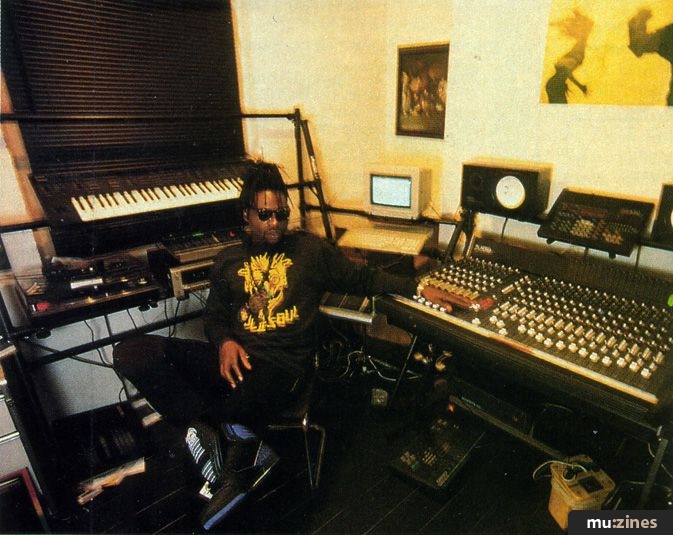
MOVING ON ONCE more to the equipment behind Soul II Soul's music we come back to Jazzie's B's business sense.
"Part of the reason I'm here today is because the technology was available to me", he explains. "Basically, in the early days, instead of rushing around in fast cars and expensive jewellers from the money we were making, you can see where it was spent. Tony Addis at Addis Studio in Harrow Road made things available to us and gave us our first break. I still have in our museum a four-track Yamaha cassette that was one of the first four tracks around, now we own our own E16. We own our own pre-production suite - my last pre-production suite was that four track!"
"The availability of technology will lead to one of two things: things will either get better or they will get worse - like for the musos that got lost in their own little worlds because they'd banged on their guitars for too long without any direction. What happens to us at about five, six in the morning when we're in the programming suite is we end up getting out the video games. Technology will either lead to people making more advanced music or it'll fuck 'em up even more. At the end of the day, if you know what you want and you're strong enough to hold on to it, then you can only do something constructive."
It turns out that most of Jazzie B's writing takes place on a DX7 II - a fact of which he is not overly proud.
"I'm about to purchase a music workstation" he announces in his defence, "probably the Korg M1, but I've been told to wait because Roland have just bought out the W30. At the moment I'm using the DX7 because it's the most familiar system."
A new Status bass guitar has also been a source of writing inspiration.
"I'm not a brilliant bass player but I can write grooves on a bass which my programmer, Gota, can then interpret. I have, throughout my career used every kind of natural musical thing that can be played from a bass to a guitar to a wind instrument. String, wind, the technical end, I've been there and back."
The Reggae Philharmonic Orchestra have provided Soul II Soul with the rich strings that grace both the 'Keep on Movin'' and 'Back to Life' singles and helped add depth to Club Classics. Strings, it seems, are a weakness of Jazzie B...
"That's from the old days of me working at Nova with orchestras" he explains. "I really adore strings. I could have anyone playing a violin or something and I'd just sit there and listen because there's something about the sound that resonates through the wood. And it can be very, very funky. Hence all the strings on the album. That was a real find for me, the RPO."
After the interview is over, a short walk will take us to Jazzie B's pre-production suite where he will pose for photos in front of a new Fostex E16, Soundtracs MIDI desk and Akai S1000 and S1000PB samplers. The remainder of the equipment reads like a choice selection of currently desirable technology: Yamaha NS10M monitors, Atari 1040ST, Yamaha TX802 and TX16W, Korg DW8000, Oberheim Matrix 1000, Roland Octapad, Roland A110 and A880, SRC AT sychroniser, Fostex 4050 SMPTE synchroniser/autolocator, Lexicon LXP1 reverb and a Sony DAT machine. A Yamaha QX3 lies discarded underneath two Technics SL1210 turntables and Phonic mixer.
"We've just got a 24-track MIDI/16-track setup now" comments Jazzie B. "We've set it up with Gota, who was with the Japanese band Melon and now does a lot of our programming for us.
"We're just getting to grips with it at the moment. Ideally we'd like a setup with an SSL desk but I guess we'll have to save up a bit more first. We're saving up, literally, to buy little bits and pieces. It's basically a pre-production suite at the moment."
Although a TR808 put in an appearance shortly after the interview, it's a Casio RZ1 drum machine that is chosen to co-star in the photo session. Strange when you consider that most of Soul II Soul's drum sounds come from the two Akai machines...
"It's usually samples these days", confirms Jazzie B. "We don't have a drum machine, although in my early days I used the inevitable 808 or 909. Now it's a combination of various sounds - we keep all our own samples of sounds which we've gathered over the years from various records of musicians that we know."
You see, that's the point: while many other artists are looking to use the hippest technology to give their music credibility, one of the most credible and musical albums of the year has been put together with a healthy disrespect for the technological details.
"Maybe in music lessons in schools now they should teach sequencing and using equipment like the Fairlight", muses Jazzie B. "Look at the huge catalogue of music there is in the past to influence you; you're jesterin' if you don't use that to your advantage. When I think that the first tune I made, 'Fair Play', was made just cutting up two records - I didn't even have a sampler then - cuttin' up beats it was, with a guy playing bass over the top. I played that tune for two years and it all snowballed from there. These things can happen, you know? In my wildest dreams I would never have thought it could happen to me. It can really happen to you. You've just got to believe in what you do and make something a little bit more constructive than the bullshit we continue to hear on national radio and TV. Power to the pirate stations."
A suitable note on which to close an interview. Unless there's anything you'd like to add, Jazzie.
"To the people who are making music in their own studios, if they live in the kind of places I've lived in, be careful, man - somebody upstairs is biting you!"
More with this artist
 In The Studio With Soul II Soul (Soul II Soul) |
Publisher: Music Technology - Music Maker Publications (UK), Future Publishing.
The current copyright owner/s of this content may differ from the originally published copyright notice.
More details on copyright ownership...

Music Technology - Jun 1989
Interview by Tim Goodyer
Help Support The Things You Love
mu:zines is the result of thousands of hours of effort, and will require many thousands more going forward to reach our goals of getting all this content online.
If you value this resource, you can support this project - it really helps!
Donations for April 2026
Issues donated this month: 0
New issues that have been donated or scanned for us this month.
Funds donated this month: £0.00
All donations and support are gratefully appreciated - thank you.
Magazines Needed - Can You Help?
Do you have any of these magazine issues?
If so, and you can donate, lend or scan them to help complete our archive, please get in touch via the Contribute page - thanks!
Please Contribute to mu:zines by supplying magazines, scanning or donating funds. Thanks!
Monetary donations go towards site running costs, and the occasional coffee for me if there's anything left over!

 @mu_zines
 RSS Feed
 Blog
Blog