


Magazine Archive
Home -> Magazines -> Issues -> Articles in this issue -> View
Yamaha DMP7 Digital Mixer | |
Digital Mixing ProcessorArticle from Sound On Sound, July 1987 | |
A fully automated, digital mixer with built-in multi-effects and full MIDI control for under £3,000? Hard to believe. David Mellor visits the Yamaha research and development centre in London to try out this amazing innovation in the flesh and discovers that the DMP7 is no fantasy!
A fully digital mixer with total automation for under £3,000? The last studio to buy a digital console paid several hundred thousand pounds for one and ended up sending it back to the factory. David Mellor visits the Yamaha research and development studio in London and examines the latest in mixing technology.
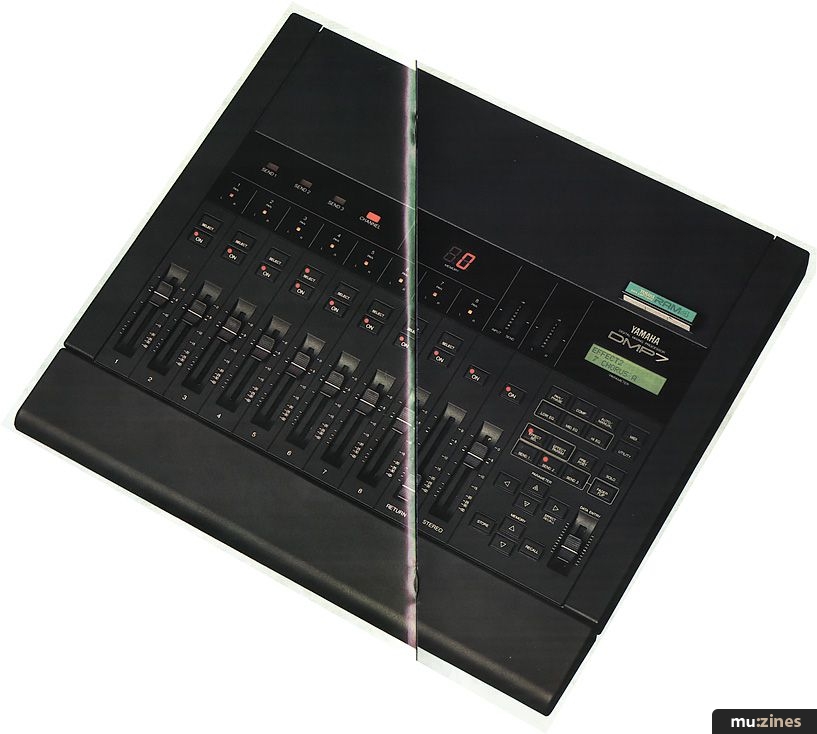
There are several mixers on the market with MIDI facilities. Most only provide MIDI controlled muting of channels, while only one that I know of in a comparable price bracket - the Akai MPX820 - can reset fader and EQ settings under automatic control. Apart from a couple of very recent desks, conventional large console automated mixdown (via a specialised computer rather than MIDI), can only deal with channel mutes and fader levels. EQ and auxiliary sends have to be dealt with the old-fashioned way, by hand.
Yamaha's latest mixer (which they prefer to call a 'mixing processor') not only offers MIDI control of virtually every function, it is digital too - by which I mean from audio in to audio out. No voltage controlled amplifiers are used. It may not be exactly studio-sized but the DMP7 boasts studio performance and is a definite first step in the right direction, and as we shall see later there is the possibility of expansion.
As a starter, I shall list the DMP7's main features:
8 line-level input channels
Stereo output
3-band equalisation on each channel
3 auxiliary sends
Sends 1 & 2 are dedicated to internal digital effects processors
Send 3 has an internal effects processor or can be routed via an external processor
3 stereo auxiliary returns (you can only see one but I can assure you that it works like three!)
Ability to memorise all control settings (scenes)
Setting of controls via MIDI
That's enough for now, let's go round the back...
EXTERNALS
The back panel of the DMP7 might look like any other mixer but remember that behind every audio socket is a 16-bit 44.1 kHz digital-to-analogue or analogue-to-digital convertor. That's Compact Disc quality by the way, so no quibbles about the spec from me.
Eight channel inputs are provided on ¼" jack sockets, each having a rotary level trim which can cope with a range of inputs from -20dBu to +4dBu nominal level. This means that the DMP7 will be equally at home in a pro studio or in a home Tascam/Fostex set-up.
There is a mono effects send and stereo return, just in case you can think of an effect you want to use that Yamaha haven't included internally. (Yes, there are a few.)
The stereo output comes in two varieties, ¼" jack and 3-pin XLR type. The difference is that the XLR provides a balanced output which can make life easier for the engineer with fully professional gear.
The headphone output is something which everyone would expect, the foot volume controller socket is just a little unusual on a mixer. This will probably be a godsend to ex-sewing machinists turned recording engineers because it can control the level of the stereo output instead of the conventional fader. Either that or act instead of the data entry control if you wish. The familiar three MIDI sockets appear with the standard functions but two extra DIN sockets are worth a mention. I did say earlier that this was an eight channel mixer. Well, how about sixteen channels? Twenty-four? Thirty-two?
The 'Digital Cascade' in and out sockets make it possible to link several DMP7s together to create a mixer as big as you like. "Yes, you can do that with any mixer," says the sceptic. This is true, of course, but by cascading outputs to inputs there is bound to be a loss in quality. Yamaha overcome this by doing it digitally, direct from bus to bus. They do not mention an upper limit to the number of DMP7s that can be linked in this way - and I cannot see any reason why there should be one - so the next time Trevor Horn syncs up six 24-track recorders, he might do well to mix down using 18 DMP7s. It would still be cheaper than an SSL!
CONTROLS
Not many of these. I'm afraid. The days of the thousand knob mixer would seem to be coming to an end. It will never be as easy to call up a function and display its setting or make an adjustment with the data entry slider as it is to reach instinctively for the right knob and make the required change. Yamaha's little mixer would require around 250 motor-driven controls if they were all to be dedicated to one function apiece and its price would be sky-high. Fortunately, it does have enough buttons so that you don't have to press the same one fifteen times to get to the function you want - often.
Each channel has one motorised fader, two buttons with indicator LEDs and a group of three LEDs which give a rough indication of where the channel is panned in the stereo image. The fader and channel-on button do not need further explanation. The 'Select' button is something not found on ordinary mixers, you press this when you want to change an EQ setting or auxiliary send level on a particular channel. This tells the mixer which channel you want to adjust.
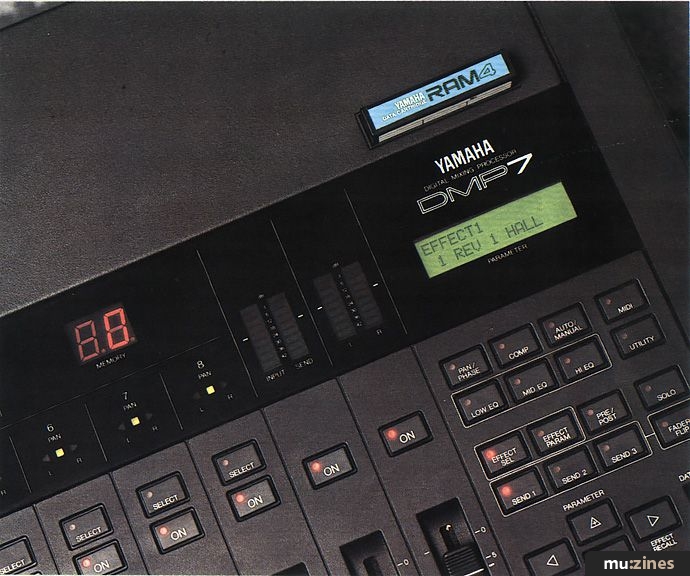
Moving across to the right we find the real works of the DMP7. Twenty-four buttons and a data entry slider with which all changes are made. Let's look at EQ as an example: To set the EQ for any particular channel, first of all the 'Select' button on that channel is pressed. There are three equalisation bands unimaginatively named Low, Mid and High with ranges 32Hz to 800Hz, 250Hz to 8kHz and 1kHZ to 18kHz respectively. Sensible ranges with sufficient overlap.
The parameter keys select the parameter to be adjusted in a similar manner to Yamaha's SPX90 effects processor. As well as the centre frequency of each band, the gain can be adjusted from -15dB to +15dB. The 'Q' or bandwidth ranges from 0.1 to 5 and, for the Low and High sections, and the characteristic can be swapped between peaking and shelving responses (no Q adjustment on shelving).
I shouldn't have to tell you that this is a better specified EQ section than you will find on most mixers under a hundred grand. I can't comment on the 'sound' too much as I prefer to use equipment 'in anger' before making my mind up, but a first trial certainly convinced me that this is a serious piece of equipment.
Capable though the EQ section is, the exciting parts of the DMP7 are the effects loops. I mentioned earlier that there are built-in effects; cast a beady eye over this lot!
Sends 1 & 2 can access these effects:
Rev 1 (Hall), Rev 2 (Room), Rev 3 (Vocal), Rev 4 (Plate), Flange A, Flange B, Chorus A, Chorus B, Phasing, Tremolo, Symphonic, Early Reflections 1, Early Reflections 2, Gate Reverb, Reverse Gate, Delay L & R, Stereo Echo
Send 3 can Access:
Stereo Echo, Flange, Chorus, Phasing, Panpot
Send 3 can alternatively be routed to an external effects device of your choice and returned via an EQ section (Low, Mid or High).
These effects may sound SPX90-ish but Yamaha claim rather higher quality for them. As in the SPX90 they are 16-bit resolution but here they are full bandwidth, 20Hz to 20kHz. They sounded OK to me.
To set the send levels of each channel there is a fader flip button. This turns the channel faders into auxiliary send controls. This is the good bit - being motorised, they physically move from the positions they held when they were channel level controls to new positions corresponding to the channel auxiliary send level. An LED lights up to remind you of this. Send levels (Pre- or Post-fader) can be set for each auxiliary. When you press the flip button again to return to normal channel level mode, the faders will reset themselves to the correct position.
The auxiliary return fader works in the same way. As you set the return level for Aux 1, 2 and 3, the fader's position is memorised. When you return later to make further adjustments, the fader will automatically move to its remembered setting. It's great!
Another advantage of moving faders soon became apparent. With a conventional data entry slider, I'm sure everyone will know what I'm talking about when I say that it is always in the wrong place! You have to move it to pick up the point where the software 'thinks' it should be. When you call up a new parameter to adjust on the DMP7, however, the data slider automatically moves to the proper level. It's a small point but you do get the feeling it's you, rather than the machine, that's in control.
MEMORY
As supplied, the DMP7 has 30 memories, each of which can store the setting of every parameter (Yamaha call a complete set of parameters, fader settings, EQ etc, a scene). That's what I call handy - a sort of table-top SSL - and when you call up a scene from memory, each control is reset instantly or with a fade-between-scenes time that you programme, up to ten seconds. Each scene can have a title so you will not lose your place and get the wrong mix at the gig.
If 30 memories are not enough for you, then the RAM4 cartridge (as used by other Yamaha equipment) can hold 67 more, making a total of 97 memories available at the touch of a button. Marvellous.
MIDI
Powerful though the DMP7 is, wait till it is connected to a MIDI keyboard or sequencer. Want to set channel levels from a velocity-sensitive MIDI keyboard? Read on...
The simplest way to control the DMP7 from a sequencer is to use MIDI program changes to switch from scene to scene. For example, when you change from program 21 to 22 on your master keyboard (which would, of course, change the program on every other receptive MIDI device in your system) you can have the DMP7 changing from scene 63 to 85 or from 72 to 16 etc. Note that program numbers and scene numbers do not have to be the same. There are four MIDI control banks available, each of which can be set to receive on a different MIDI channel and can be programmed with a completely different set of program change assignments.
The time taken to change between scenes can be set, as I described earlier, between 0.1 and 10 seconds.

It is also possible to use the DMP7 as a fully automated - and I do mean fully automated - mixer by exploiting its real-time MIDI control potential.
All parameters on the DMP7 can be controlled via MIDI. That means all 206 parameters, from EQ Mid frequency on channel 4, to compression ratio. (Did I mention there is a compressor available on the stereo output?) Actually, this touches on a point that I'm not too sure about - and neither are the guys at the Yamaha R&D studio. I was fortunate to be there on the day the first production model DMP7 in the UK (22nd off the line) arrived, so that was the one we worked with.
Unfortunately, the only owner's manual we had referred to the prototype. We found that the production model appeared to have 255 MIDI controllable parameters but we couldn't find out what the other 49 were! That will be a nice surprise in store for you when you buy one.
Setting up a DMP7 for the very first time is a lengthy business because you have to assign all the different parameters to MIDI controller numbers. Each parameter has a parameter number (listed in the manual) and each of these can be assigned to any MIDI control change number or note-on number. Since controllers and notes have values associated with them (velocity in the case of note-on messages), they can be used to both select and set variable parameters such as fader position, EQ frequency, reverb time and all the rest.
What all this means is that you can record changes you make on the DMP7 in real-time into a MIDI sequencer. When you replay the sequence, the DMP7 will replicate your changes exactly. There is a word for this - automation. Not just fader automation but full console automation. OK, it's just a little mixer, but it is a pointer to the future, and as I said earlier you can link several together. If you are used to MasterMix or a similar computer-based automation system, don't expect the DMP7 to be quite as simple to operate, you will have to think about what you are doing a bit more carefully.
It is possible to edit your DMP7 mixes. Previously recorded data can be replayed from the sequencer into the DMP7 and changes made, re-recording onto another sequencer track. These changes are limited to fader, panpot and EQ but don't forget that if your sequencer has editing facilities, you can change data in exactly the same way as you would for a sequence of notes.
[Editor's note: Steinberg Research have been commissioned by Yamaha to produce DMP7 editing software to run on the Atari ST computer. This will be demonstrated by Yamaha at the APRS exhibition, Olympia, in late June.]
If live performance is your main interest and you reject sequencers 'on artistic grounds', then you will still be able to use the MIDI facilities of the DMP7. As I said, any parameter can be adjusted by any MIDI controller or note-on message. Child's play it is, too, to set the pitch bend wheel of a keyboard to change the modulation frequency of the chorus effect, or to set the modulation wheel to change the centre frequency of the EQ.
One word of warning here. There is an order of priorities in the DMP7. I thought it might have been possible to generate a waa-waa effect by changing the EQ frequency in realtime. Unfortunately, there was a distinct time-lag of around two seconds between moving the controller and hearing the effect. Other things, like changing the reverb time, happened more quickly.
I don't like to be negative, and there is little point in criticising the DMP7 for what it cannot do - particularly as there is nothing else on the market that can approach its capabilities - but this is an example of how easy it is to read the equipment spec and assume an ability that doesn't exist. The moral, as with any piece of hi-tech equipment, is try before you buy - and insist on talking to a knowledgeable salesman, they are worth their weight in platinum.
Another point I must add is that using velocity information to control the DMP7 is sometimes a bit tricky. In their MIDI implementation, Yamaha use a note-on message with zero velocity to indicate a note-off. This can cause confusion to the poor old DMP7 so please bear it in mind, along with the fact that you cannot use aftertouch as a MIDI controller. There is a way round this problem, which is to buy Yamaha's MEP4 MIDI Event Processor which performs operations on MIDI messages according to whatever you fancy - convert aftertouch information into pitch bend information, for instance. I am sure anyone seriously into MIDI would have one of these on his or her shopping list.
IN USE
When I read a review of a piece of equipment, this is always the most interesting section. It's only when you get down to some serious work, not in the presence of representatives of the manufacturer, that you really find out its capabilities - or otherwise. As this is more in the nature of a preview than a review - since fully operational production models have been exceedingly thin on the ground, I shall have to restrict myself to speculating on different ways the DMP7 might be used.
Eight input channels is not a lot - he says stating the obvious - so you couldn't really use this as a multitrack mixer, unless you were content just to use eight tracks, two external effect returns, and have no extra instruments synced up. Perhaps as a live keyboard mixer it would have advantages, but unless you're on a bit more than the proverbial twenty quid a night it would be difficult to justify the cost.
What Yamaha made clear to me is that they do not have a specific function in mind for the DMP7. They have crammed it full of all the facilities they could think of. They've made it Compact Disc quality and put it out at a price which isn't out of sight (£2,999 inc VAT). The idea is that if a machine like this is made available to enough people then it will effectively find its own function in the scheme of things. For instance, a 16-track studio could use it in conjunction with their main analogue mixer to automate those bits of a track which need it. There are always several tracks of the multitrack tape which need no fader juggling from one end of the mix to the other.
Perhaps adventurous souls will use the total automation capability to create more complex and faster changing mixes than ever heard before. Audio-visual companies could use it to help automate their presentations. It could easily find a very nice slot in a video editing suite where, often, only a small number of audio tracks are used. The video side of these editing suites is highly automated. The audio mixing is usually not.
It's funny but the more you think about possible applications for the DMP7 the more ideas you get. There is, by the way, a companion unit which can be rack-mounted like the DMP7 and provides microphone or balanced line inputs, called the MLA7. Phantom power is provided and also, as a sort of by-product, insert points.
GOSSIP
If you keep your ear to the ground and your eye on the ball (!) there is always a little titbit to be picked up. Today's morsel is that a certain audio company, which shall not remain nameless for long (HHB), is working on a digital interface which will link the DMP7 to a Sony F1 type digital recorder. This seems extremely sensible as it will cut out one D/A and one A/D conversion which may have a slight deleterious effect on sound quality. Who knows what else is going on?
As a closing thought, if anyone out there is wealthy enough to chain two or more DMP7s together, there is someone out here (ie. me) who would like to come and have a look. (Contact me via SOS.) I'm looking forward to it already!
Price : £2,999 inc VAT.
Further info from Alan Martin, (Contact Details).
Also featuring gear in this article
Rediscovering The Yamaha DMP7
(SOS Dec 92)

Yamaha DMP7 Mixer
(MT Feb 87)
Browse category: Mixer > Yamaha
Featuring related gear

Publisher: Sound On Sound - SOS Publications Ltd.
The contents of this magazine are re-published here with the kind permission of SOS Publications Ltd.
The current copyright owner/s of this content may differ from the originally published copyright notice.
More details on copyright ownership...

Sound On Sound - Jul 1987
Review by David Mellor
Ads for Gear in this article:

Previous article in this issue:
Next article in this issue:
Help Support The Things You Love
mu:zines is the result of thousands of hours of effort, and will require many thousands more going forward to reach our goals of getting all this content online.
If you value this resource, you can support this project - it really helps!
Donations for April 2026
Issues donated this month: 0
New issues that have been donated or scanned for us this month.
Funds donated this month: £0.00
All donations and support are gratefully appreciated - thank you.
Magazines Needed - Can You Help?
Do you have any of these magazine issues?
If so, and you can donate, lend or scan them to help complete our archive, please get in touch via the Contribute page - thanks!
Please Contribute to mu:zines by supplying magazines, scanning or donating funds. Thanks!
Monetary donations go towards site running costs, and the occasional coffee for me if there's anything left over!

 @mu_zines
 RSS Feed
 Blog
Blog