


Magazine Archive
Home -> Magazines -> Issues -> Articles in this issue -> View
Dual Mic Pre-amp | |
Article from Electronic Soundmaker & Computer Music, April 1984 | |
Twice the gain
Mark Stuart describes a neat two channel mic pre-amp with switchable gain.

This circuit was designed as an addon to adapt two line inputs of a PA amplifier or mixer for use with high (50k ohm) or low (600 ohm) impedance microphones.
The low noise, wide dynamic range and high output drive capability make the circuit a versatile general purpose gain block which should find many other uses in audio systems. Each channel has a switched gain control giving 10, 20, 30, 40 or 50dB of gain. The use of a switched gain facility greatly eases setting up a system, and allows better accuracy and repeatability than a continuously variable control.
The frequency response is flat from below 10Hz to 20kHz. Above 20kHz a gentle roll-off has been introduced to eliminate interference problems.
Each output is capable of driving any load of 600 ohms or more.
Distortion and noise performance is very good and it may well be found that the pre-amp can be used to improve substantially the noise performance of an existing set up.

Fig 2 Component overlay and switch wiring
(Click image for higher resolution version)
Construction
Both channels are built on a single printed circuit board. The circuit must be housed in a metal case to prevent hum and interference pick-up. Begin construction by assembling the printed circuit board. Refer to the component overlay (Fig 2). First insert wiring pins into the board for the connections to the inputs, outputs, power and gain control switches. The splined part of the pins should be pressed well into the board to provide a firm fit before soldering each one. Note that the component numbering is duplicated for the second channel.
Insert and solder the components one by one starting with the resistors. The capacitors (except C6) must be inserted the right way round. A line or minus sign (-) on the body of the capacitor is used to indicate the negative lead. Often you'll find that the negative lead is shorter than the other one. It is important to use miniature low leakage capacitors as specified.
Complete the board assembly by fitting an 8-pin IC socket ready for IC1. Next drill the case for the board, switches and sockets. Make sure that there will be enough space for the batteries when all the parts are fitted.
The four gain control resistors R7, 8, 9 and 10 are fitted directly to the pins on the rotary switches. Fig 2 shows the wiring of each switch. The pre-amp is switched on only by the channel two switch. If required the channel one switch power terminals can be wired into circuit to enable either channel switch to turn on the power. The switch wiring is best done before the switches are mounted in the case.
After fitting the switches, mount, the printed circuit board in the case using two long screws with two nuts on each as spacers. These screws also serve to connect the negative supply rail to the case, so ensure that they are tight. A shakeproof washer is useful here.
Connect the wire from the switches to the board, as shown in Fig 2. The two batteries are connected in series to provide an 18 volt supply for IC1. Cover the join between the battery clips with a short length of sleeving to ensure good insulation.
Finally make the screened connections to the four jack sockets. When construction is complete, fit IC1 in its socket, connect two PP3 batteries and secure them in position with double sided adhesive tape. The pre-amp is now ready for testing.
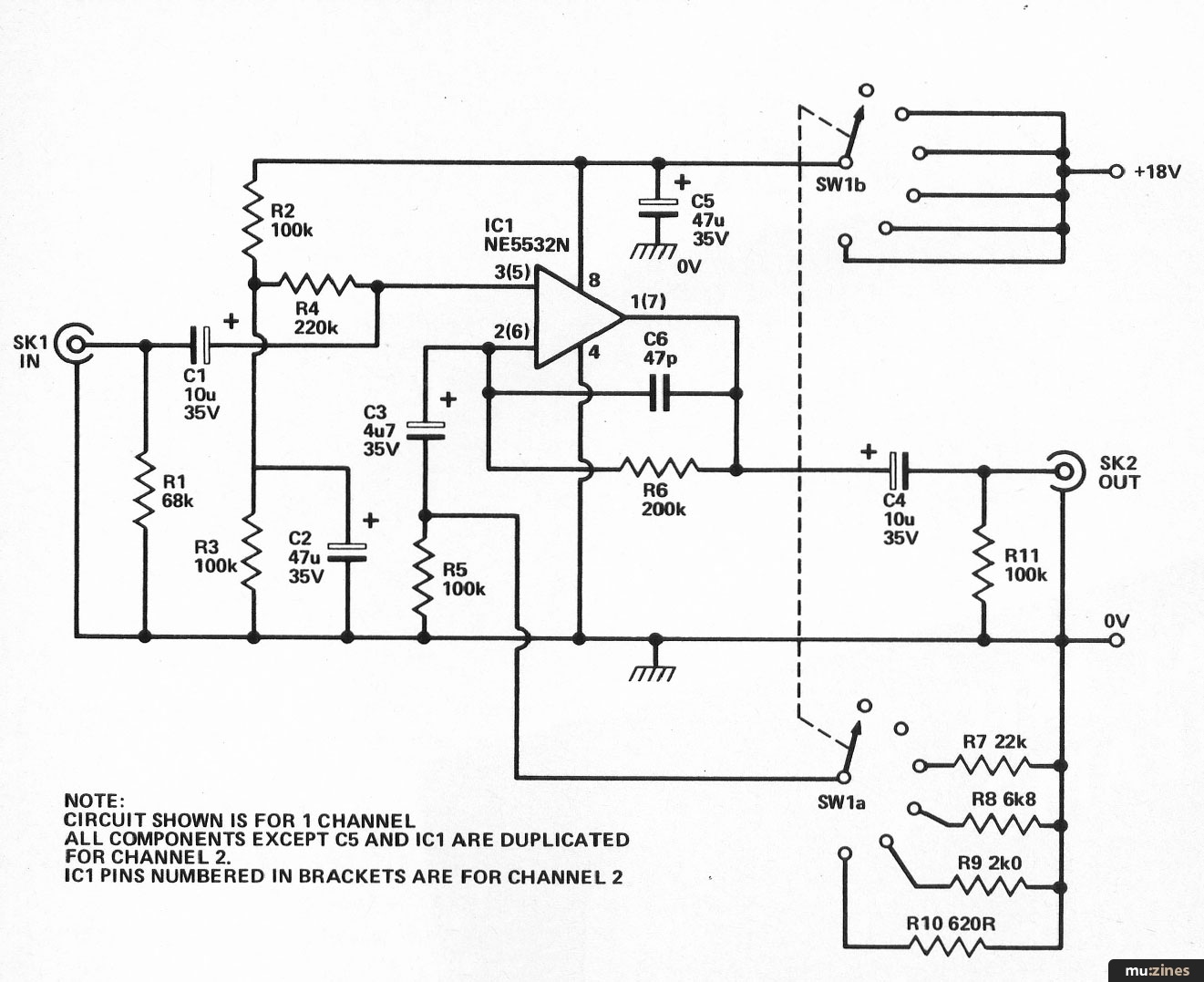
Fig 1 Circuit of one channel of the pre-amp
(Click image for higher resolution version)
The Circuit
The circuit of the dual mic pre-amp is one that appears very frequently. Each channel is a non inverting amplifier with adjustable negative feedback. There are two input points to the amplifier. Signals fed into the + (non inverting) input appear at the output highly amplified, and of the same polarity. Signals fed into the — (inverting) input are amplified by exactly the same amount, but their polarity is reversed. That is, a positive input signal produces a negative output signal.
Negative feedback is obtained by connecting a controlled amount of the output signal to the inverting input. If the feedback network were to be a direct link all of the output signal would be fed back and the gain of the amplifier would be one. With no feedback applied the gain rises to the "open loop" gain of the op-amp. The "open loop" gain is the gain of the amplifier without feedback. The gain of the amplifier can be accurately controlled by the amount of negative feedback applied. In the pre-amp circuit R6 provides the feedback. Some of the feedback signal is conducted away via R5, and one of the resistors R7-10, depending on the gain control setting. The values of the gain control resistors have been calculated to provide the 10dB gain steps required.
The other components in the pre-amp provide correct DC operating voltages for the IC, and couple the input and output signals.
Testing
Connect a suitable signal source and PA amplifier to channel 2. Make sure that the PA gain is turned well down, then switch the channel 2 gain control to the 10dB position. There should be a small increase in signal level. Test the other gain positions in turn and check that the signal level increases in equal steps. Note that when using the higher gain positions the preamp may overload the PA system input circuits, causing distortion, if so reduce the source signal level. Repeat the tests for channel 1.
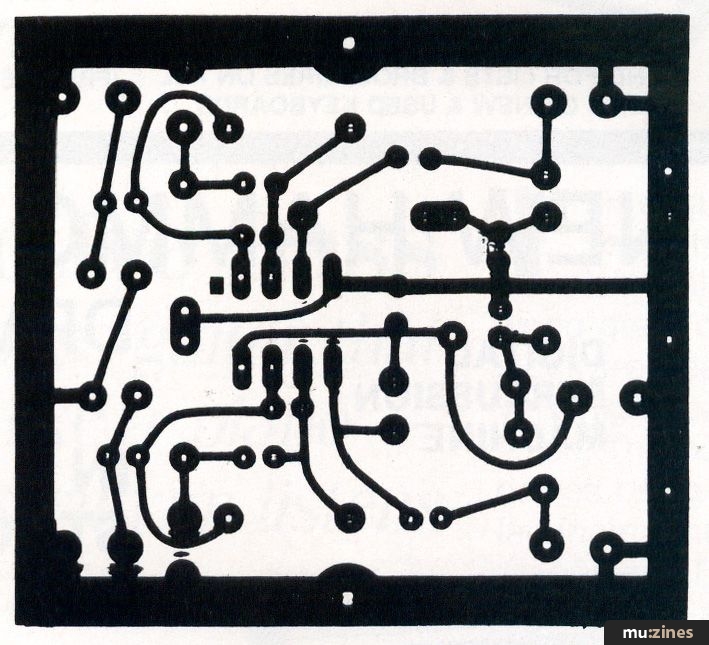
The PCB for our Dual Mic Pre-amp.
Parts Listing
| Resistors | |
| R1 | 68k (see note) |
| R2,3,5,11 | 100k |
| R4 | 220k |
| R6 | 200k |
| R7 | 22k |
| R8 | 6k8 |
| R9 | 2k |
| R10 | 620R |
| Note: R1 is specified for 50k input impedance. Change to 620R for 600 ohms. | |
Capacitors | |
| C1,4 | 10u 35V min low leakage electrolytic |
| C2,5 | 47u 35V min low leakage electrolytic |
| C3 | 4u7 35V min low leakage electrolytic |
| C6 | 47p ceramic |
Semiconductors | |
| IC1 | NE5532N |
Miscellaneous | |
| SW1 | 2 pole 6-way rotary switch* |
| SK1,2 | 0.25" standard jack sockets* |
| Printed circuit board, metal case, IC socket, PP3 battery clips, knobs, screws etc. | |
| *two sets required | |
More with this topic
 Adding an Independent Tracking Output to the 4780 Sequencer |
 Technically Speaking (Part 1) |
 Putting on the Style |
 Lab Notes: Computer Music Without the Computer - or: What to do 'til your processor arrives. |
 Workbench - STAGE LIGHTING INTERFACE BOARDS |
 BeeBMIDI (Part 1) |
 Experimenting With Analog Delay |
 Understanding Electronics - How To Make Music Projects |
 Sample & Hold Resurrection - what to do with your analog sample and hold once you've gone digital |
 Phantom Power Module |
 Sound On Stage |
 Voice Frequency to Voltage Converter |
Browse by Topic:
Electronics / Build
Publisher: Electronic Soundmaker & Computer Music - Cover Publications Ltd, Northern & Shell Ltd.
The current copyright owner/s of this content may differ from the originally published copyright notice.
More details on copyright ownership...

Electronic Soundmaker - Apr 1984
Donated & scanned by: Mike Gorman
Feature by Mark Stuart
Help Support The Things You Love
mu:zines is the result of thousands of hours of effort, and will require many thousands more going forward to reach our goals of getting all this content online.
If you value this resource, you can support this project - it really helps!
Donations for June 2026
Issues donated this month: 0
New issues that have been donated or scanned for us this month.
Funds donated this month: £0.00
All donations and support are gratefully appreciated - thank you.
Magazines Needed - Can You Help?
Do you have any of these magazine issues?
If so, and you can donate, lend or scan them to help complete our archive, please get in touch via the Contribute page - thanks!
Please Contribute to mu:zines by supplying magazines, scanning or donating funds. Thanks!
Monetary donations go towards site running costs, and the occasional coffee for me if there's anything left over!

 @mu_zines
 RSS Feed
 Blog
Blog