


Magazine Archive
Home -> Magazines -> Issues -> Articles in this issue -> View
Powerstation! | |
Ensoniq VFX-SDIIArticle from Sound On Sound, September 1990 | |
Ensoniq's flagship workstation has recently received some very welcome updates — new piano samples, extra stereo outputs, multitrack sequence recording and step-time entry, and more. Paul Ireson satisfies his curiosity!
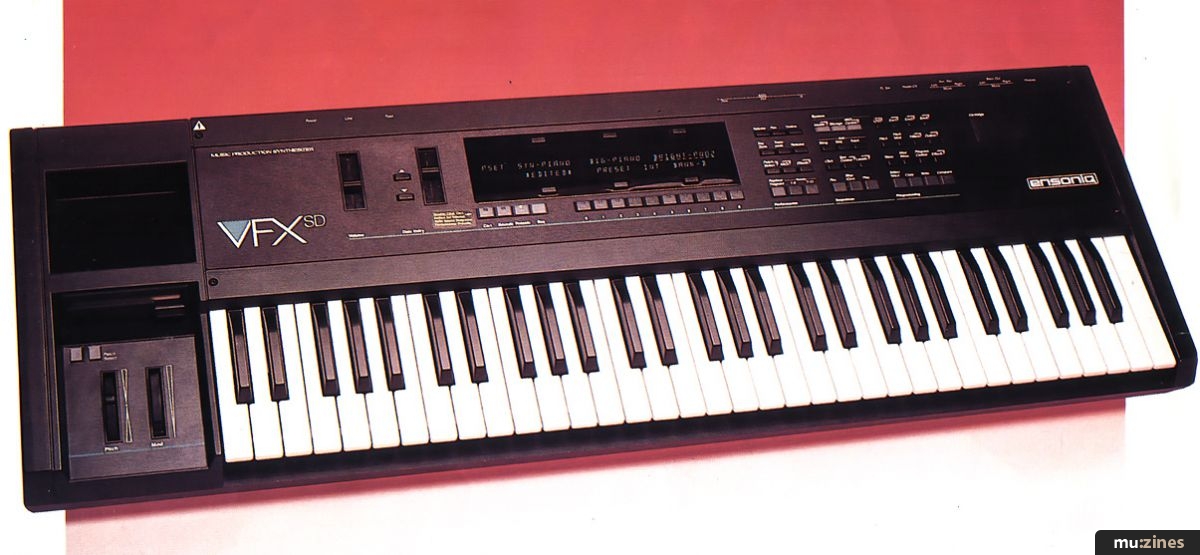
Ensoniq seem to be building a stable of quite formidable VFX-based products. The last couple of months have seen the launch of the SQ1, with a rack-mount version to follow imminently, and now there is an updated version of the VFX-SD: the VFX-SDII. The original VFX won well-deserved acclaim upon release for its outstanding synthesis facilities, offering the potential for unusually powerful and expressive sounds. The VFX-SD added a disk drive and 24-track sequencer to create an impressive workstation, and now the SD design has been uprated, with a new version of the operating system adding several new features and new piano Waves to those available before.
I won't delve into the features of the SDII in all that much depth here, as previous reviews of the VFX [SOS June-July 1989] and SQ1 [SOS July 1990] have explained the synthesis techniques and sequencer operations. The synthesizer section of the SD is essentially the same as that of the basic VFX, although some extra Waves have been added, and there are differences in the effects section. One significant difference is that whereas the VFX only has one set of stereo outputs, the SD has two, which allows you to route some sounds through the stereo effects section and still have a separate stereo bus left over to output 'dry' sounds.
The SD's single sounds are called Programs. There are 60 ROM Programs and 60 user Internal Programs (a further 60 can be stored on a memory cartridge). As on the basic VFX, up to six Voices are used in each Program, and the Patch Select buttons above the modulation wheels allow you to switch between four different combinations of active and muted Voices. (The SQ1 uses three Voices per Program, and does not have the Patch Select buttons). Even if you're not familiar with the system, you can imagine its power as a performance feature, allowing you to switch from a standard fuzz guitar patch to a howling feedback patch, or whatever.
Presets are performance-oriented arrangements of up to three Programs. There are 20 Internal Presets, in two banks of 10. Another 20 can be stored on 3.5" disk. Preset parameters include not only Key Zone, Transpose, and Volume, but also parameters like Envelope Release Time, which allows you to quickly tweak Programs to work in their new context, without actually changing the Program itself. If you just want to play the SD, you can select either Sound or Preset Mode. In fact, even when selecting Sounds, you are operating within a kind of Preset buffer: you can layer a further two Programs on top of your primary Program, by double-clicking the buttons to select them, edit whichever Preset parameters you need to, and then save the new preset.
The other SD mode of operation is Sequencer mode. 60 memory locations are provided, and each can be used for either a Sequence or a Song. The total sequence memory is 75,000 notes. The sequencer has 24 tracks, half of which are used when recording Sequences, and the other half for Songs. It works like this: when you create and record a Sequence, you have 12 tracks to work with. When you chain the sequences together into a Song, you immediately have 12 empty tracks running alongside the sets of 12 Sequence tracks, to record new data in. This system is typical of the way that the whole of the VFX family operating procedures work, in that it is designed to reflect the ways in which musicians actually work. Most sequencer users start with relatively short loops — four or eight bars — and then string the basic sections together before developing their ideas.
The sequencer's user interface does not have the visual sophistication of a computer screen, but the functions are there and present themselves when you need them. For example, you don't have to decide how long a Sequence is going to be until you record the first track. When you've recorded that, a prompt asks whether you want to keep the first X bars, or start again. When recording subsequent tracks, whenever you've finished recording, you automatically enter audition mode, in which you can listen to the old and new versions of the sequence, and decide which you want to keep.
Programs that are to be used with a Sequence are assigned to the Sequence tracks exactly as they would be in a giant 12-part Preset. With the control you have over the VFX-SD's system settings, you can of course use some tracks as purely local tracks, with internal Sequence data or the keyboard playing an internal Sound, whilst others are used to control external MIDI instruments, or respond to incoming MIDI data.
As it happened, the VFX-SDII came into my hands just as my not-so-trusty Atari ST went off to be repaired, and as a result I used it as my only sequencer for a while. Whilst I did miss the more sophisticated visual aspects of computer sequencing, and higher level organising and editing functions, for basic work — ie. actually writing music and getting to a 'good demo' stage — the SDII's sequencer is excellent, due simply to the fact that its design makes fast and intuitive working possible. Also, although it lacks those higher-level editing functions that computer sequencers offer, eg. algorithmic composition and manipulation, it does have the full range of important editing facilities, right down to an excellent event editing section.
MAKING WAVES
Synthesis on the VFX starts with Voices. Each Voice is based on a single digital oscillator which can play any of the 149 Waves. These are arranged in 13 groups: String; Brass; Breath; Bass; Tuned Percussion; Drums; Multi-Drums; Transwave; Multiwave; Waveform; Piano. The first six groups, and the Piano group, contain digitised recordings of acoustic and electronic sounds, and rather than separate attack and sustain portions of sounds, the VFX's Waves have both. In addition, many are multi-sampled. The Drum and Percussion groups contain a selection of drum sounds, one per Wave. Multi-Drum waves are complete multi-sound drum setups, which provide the basis for creating your own kits.
The Transwave, Waveform, and Inharmonic groups contain sampled synthesizer waveforms, although the Transwaves are rather special. Each of the 17 Transwaves is actually a wavetable containing around 100 variations of a basic waveform. When a Voice plays a Transwave, it can move through the wavetable as the note is held — the waveform is therefore changing progressively, and the result is that you can generate complex timbral shifts even before any other sound-shaping techniques are brought to bear. Classic pulse width modulation and heavy filter sweep effects are both possible (the latter through the provision of four resonant wavetables, compensating for a lack of resonance on the VFX's own digital filters).
The movement through wavetables can be modulated by any of several mod sources: LFO, Envelope 1, Envelope 2, Noise, Mixer, Velocity, Keyboard, Timbre (a parameter that can be set externally to the Program when it is used in a Preset or Sequencer track), Foot Pedal, Pitch Bend, MIDI Controller, Pressure and Volume, Mod Wheel and Pressure, Mod Wheel, Pressure. Modulation routing is one of the VFX's strong points, in that the above sources can be used to affect every stage of the synthesis process, from Voice pitch through to pan position in whichever stereo bus a Voice is passed. The wavetable synthesis described above is quite similar to that employed on the classic PPG Wave, and indeed at least one set of VFX library sounds includes some very impressive 'Tangerine Dream' PPG sounds.
Synthesis doesn't end with Transwaves, however. There are three 6-stage envelopes which can be used within each Voice. One is hardwired to pitch modulation, the second to filter, and the third to Voice amplitude. The first two can also be employed as modulators. The filter section consists of a 2-part, 4-pole (24dB/octave) filter, which can be configured as one 3-pole and one 1-pole, or two 2-pole filters, according to taste. Filter 1 is low-pass only, and Filter 2 can be low-pass or high-pass.
EFFECTIVE TREATMENTS
The DSP section of the VFX-SDII offers 23 effects algorithms. Each Program, Preset, and Sequence has its own effects setup — both Presets and Sequences can use the effects setting from any one of their constituent Programs, but equally something entirely different may be required. Many of the algorithms are multi-effect programs, with two or three effects being created simultaneously.
In both single and multi-effect algorithms, there are four stereo busses that carry the VFX's sounds to the two pairs of stereo outputs. You can specify at the Voice level where sounds are to be routed, or override Voice settings when Programs are used in Presets and Sequences. The Aux bus, and nothing else, feeds the stereo auxiliary outputs. The Dry bus feeds the main stereo outputs, bypassing the effects section, and FX1 and FX2 both feed through the effects. In a single effect algorithm, FX1 and FX2 can be used to create two full stereo effects busses with different wet/dry balances. An alternative mode of operation for FX2 reduces it to a mono bus, but allows dynamic modulation of the effects mix. Several of the algorithms allow modulation of one of their parameters, such as decay time or regeneration.
In multiple function effects, FX1 feeds Effect 1 and FX2 feeds Effect 2. Mix controls allow you to set a wet/dry balance for FX2 to Effect 2, and a wet/dry balance for the output of Effect 1 through Effect 2. In algorithms containing more than two effects, the reverb part of the program is always Effect 2, and the other two are combined in Effect 1.
WHAT'S NEW?
The most obvious difference between the new version of the VFX-SD and its predecessor is heralded by a fluorescent orange sticker on the front panel, which is an idiot's guide to finding a piano sound that uses the new Waves. The Piano Sound group is new, containing one megabyte's worth of sampled grand and electric piano sounds. There is 'Megapiano' (the basic grand piano), and a slightly brighter version of it called 'MPiano Var'. These are decent multi-sampled Waves, with a good aggressive rock 'n' roll feel, although as contemporary piano sounds go, I've heard quieter, and the sounds do 'settle down' a bit too soon — the timbral shift in the decay quickly gives way to a static, if smooth, loop.
The next Waves in the group are 'Pno Noise' (the noise of a piano's mechanical action), 'Pno HiHit' (notes from the upper range, without string dampers), 'Sympathetic' (sympathetic resonances of a grand piano harp), 'EPno Soft', 'EPno Hard'. The provision of these extra 'component' Waves allows you to emphasise, and experiment with, those subtle parts of the grand piano sound that perhaps you wouldn't otherwise think of. The electric piano samples are good, although the multi-sampling is more obvious than on the grand.
If I sound slightly underwhelmed by the VFX-SDII's 'Megapiano', I have to say that it's partly because I had recently heard the new Emu Systems' Proformance module, which knocks anything into a cocked hat — but then it's a dedicated module rather than a synthesizer. The new piano Waves certainly allow you to create a decent grand piano imitation, and there is of course a Program to demonstrate this, but I can't help feeling that a lot of potential is being wasted if every keyboard can produce a great piano sound simply because it has the right samples. Synthesizers should be about new sounds, and the VFX-SDII is a superb instrument for creating them. You can, of course, use the piano sounds in more imaginative ways than just creating straight imitative sounds, and I think it is indicative of Ensoniq's recognition of this that they have provided those 'extra' Noise Waves.
Other new features, most significantly on the sequencer, have been added as a result of upgrading the operating system to Version 2.0. Many of the additions or changes are fairly minor, introduced as a result of feedback from users. These include features intended to eliminate some problems with MIDI Volume data in a MIDI loop.
More significantly, the sequencer now has a step-time entry function (as on the SQ1, in fact), and the facility to record up to 12 multiple simultaneous tracks via MIDI. This is obviously very handy if you want to transfer sequences or songs to the SD from another MIDI sequencer. The step entry function is well implemented. Other small but important changes to the sequencer include the fact that in audition mode, where you listen to the old and new versions of a Sequence before deciding which you prefer, you can now toggle between playback of the two versions on-the-fly, without returning to the start of a Sequence each time.
One of the effects programs (Chorus + Reverb + Distortion) is new, and Pitch Tables can now be loaded from cartridge without deselecting the current sound.
SUMMARY
Ensoniq pioneered the concept of the keyboard 'workstation', and they are certainly keeping it alive with this update to the VFX-SD. The VFX is an excellent basis for such an instrument, with its versatile and approachable synthesis, and Ensoniq have provided a 24-track sequencer that performs in its own field just as well: it has good editing facilities, a decent amount of memory, but above all it is very immediate. You can find all of the features that you need, and rather than bother you with things that you don't want to know, it presents you with the choices that you do have to make without requiring you to go through several levels of programming. This aspect of the VFX-SDII — the fact that it feels as if it has been designed by working musicians, as much as its synthesis and sequencing power, make it an outstanding piece of equipment. The SDII's sequencer improvements are very welcome, and the new Waves will satisfy the criticism that might possibly have been levelled at the VFX-SD, that it didn't have a really good grand piano sound.
Casting an eye around the market, one quickly finds that there actually isn't much competition for the crown which the new SD is claiming. The D70, SY77, Wavestation, and VFX are all outstanding keyboards, with enough synthesis power to keep you occupied for a lifetime. To some extent, it's more how the different instruments go about presenting you with their techniques that matters than the techniques themselves, and the VFX certainly scores in having such a well-designed user interface. So much for the synthesis side of things. In workstation terms, only the Korg T-series, Peavey DPM3, and Yamaha SY77 offer top quality synthesis bundled with a disk drive and sequencer. The old-wine-in-new-bottles T-series is slightly too expensive to be a serious proposition for most of us. There's no doubt in my mind that the VFX-SDII is a far superior synthesizer to the DPM3, although the SY77 is a tougher comparison. But more so than with synthesis, ease of use and intuitive operation is a major consideration for a sequencer, and this is perhaps where Ensoniq's instrument really comes into its own.
FURTHER INFORMATION
£2025 inc VAT.
Ensoniq GB, (Contact Details).
VFX-SDII MUSIC PRODUCTION SYNTHESIZER
- 61 note keyboard with velocity and polyphonic aftertouch
- 21 voice polyphony
- 60 ROM programs
- 60 Internal programs
- 20 ROM Presets
- 20 Internal Presets
- 60 Internal sequences and/or songs
- 24-bit DSP section
- 6 Voices per Program
- 3.5" floppy disk drive for Sound and Sequence storage.
Connections: Right/Left main output jacks; Right/Left auxiliary outputs; Phones output; MIDI In, Out, Thru; Pedal-CV In; Footswitch In
Effects algorithms: Large Hall Reverb, Small Hall Reverb, Concert Reverb, Room Reverb 1/2, Warm Chamber, Dynamic Reverb, Dynamic Hall, Gated+Room Reverb, 8-voice Chorus 1/2, Chorus+Reverb 1/2, Flanger+Reverb 1/2, Delay+Reverb 1/2, Flanger+Delay+Reverb 1/2/3, Rotary Speaker+Delay, Dirty Rotary Speaker+Delay, Distortion+Chorus+Reverb
Sequencer Edit functions: Erase Song, Song Info, Copy Song, Edit Song Steps, Append Sequence, Sequence Info, Erase Sequence, Copy Sequence, Add Bars, Delete Bars, Shift Track, Quantise Track, Erase Track, Copy Track, Transpose Track, Scale Track, Event List, Filter Track, Merge Tracks
WAVES
String Sound: Strings, Pizzi-Str, Grand Piano, Piano-Var, Digi-piano, Clavpiano, AcousGTR, Guit Var 1/2, Gtr Harmo, El Guitar, Pluck Gtr, Chukka GT, Crunch GT, Crunch LP
Brass Sound: Uni-Brass, Trumpet, Trump-Var, French Horn, FHorn Var, Saxophone, Sax Var 1/2
Bass Sound: Pick Bass, Pop Bass, Pluck Bass, Doublbass, Synbass 1/2
Breath Sound: Woodflute, Chifflute, Ocarina, Vox-Ooohs, Vocal Pad
Tuned Percussion: Marimba, Kalimba, Steeldrum, Doorbell, Potlid Hit, Syn Pluck, Plinkhorn, Flutedrum, Pno Ping, Orch Hit Kagong, Rack Bell, Crash Cym
Drum Sound: Gate Kick, Room Kick, Gate Snare, Rim Snare, Close Hat Open Hat, Ride Cym, Dry Tom L, Dry Tom H, Gat Tom L, Gat Tom H, Rm Tom L, Rm Tom H, Timbale, Conga Lo, Conga Hi, Tambourine
Percussion: Woody Hit, Woodblock, Temple Blk, Dinky Hit, Toyhammer, Agogo Bell, Slinkypop, Duct Tape, Steam Drum, Big Blast, Spray Can, Metal Dink, Vocalperc, Anvil Hit, Kick Drum, Snare drum
Multi-Drum: All Perc, All Drums, Kick Drums, Kick Drums, Snare Drums, HiHats Cymbals, Tom Toms, Percussion, Dry Toms, Room Toms, Gate Toms, Congas, Std Kit, Gated Kit Room Kit
Transwave: Spectral-X, Digital-X, Vocal-X, Doctor-X, Inharm-X, Synchro-X, Omega-X, ESQbell-X, Formant-X, Planet-X, Electro-X, Pulsel-X, Pulse2-X, Resonant 1/2/3/4
Multiwave: Multiwave
Waveform: Organ V1-4, Sawtooth, Square, Sinewave, Triangle, 1+2 Harms, 2 Harm Saw, Fretless, DpnoTine, Bubbawave, Clav Wave, ClavVar, Woodwind, Wwind Var, Pipe Organ, Brass Organ, Vocal Bell, Synth Bell, Digi Vox, Clarinet
Inharmonic: Triang-LP, Anvil-LP, Clustr-LP, Tubular-L, Noise-LP
Piano Sound: Megapiano, MPno Var, Pno Noise, Pno HiHit Sympathetic, EPno Soft, EPno Hard
Featuring related gear

Ensoniq VFX
(MT Jun 89)

Ensoniq VFX - Dynamic Component Synthesiser
(MT Jul 89)

Ensoniq VFX
(SOS Jul 89)

Ensoniq VFX
(MIC Dec 89)

Ensoniq VFX Synthesizer
(SOS Jun 89)

Ensoniq VFX-SD
(MT Dec 89)
Browse category: Synthesizer > Ensoniq
Publisher: Sound On Sound - SOS Publications Ltd.
The contents of this magazine are re-published here with the kind permission of SOS Publications Ltd.
The current copyright owner/s of this content may differ from the originally published copyright notice.
More details on copyright ownership...

Sound On Sound - Sep 1990
Donated by: Bert Jansch / Adam Jansch
Review by Paul Ireson
Ads for Gear in this article:

Help Support The Things You Love
mu:zines is the result of thousands of hours of effort, and will require many thousands more going forward to reach our goals of getting all this content online.
If you value this resource, you can support this project - it really helps!
Donations for April 2026
Issues donated this month: 0
New issues that have been donated or scanned for us this month.
Funds donated this month: £0.00
All donations and support are gratefully appreciated - thank you.
Magazines Needed - Can You Help?
Do you have any of these magazine issues?
If so, and you can donate, lend or scan them to help complete our archive, please get in touch via the Contribute page - thanks!
Please Contribute to mu:zines by supplying magazines, scanning or donating funds. Thanks!
Monetary donations go towards site running costs, and the occasional coffee for me if there's anything left over!

 @mu_zines
 RSS Feed
 Blog
Blog