


Magazine Archive
Home -> Magazines -> Issues -> Articles in this issue -> View
The King's on his throne but the President's in jail | |
Fela Kuti And King Sunny Ade | King Sunny Ade, Fela KutiArticle from International Musician & Recording World, March 1985 | |
The King and the President of Nigerian music explain the effect Juju and Afro-Pop have had on white Rock music. Report by Michael Shore
Michael Shore traces the influence of King Sunny Ade and Fela Kuti on Western music, and studies the two sides of Afro-Pop
Without Africa, there'd be no Rock music. Think about it: no Africa. No black people. No black culture. No black music. No Rock.
That's only one of the reasons why Afro-pop is culturally significant as well an unusually vibrant, lively music to listen and dance to. Afro-pop is electrified, Westernised African popular music, embodying the happy coexistence of the tribal traditions that formed Rock's embryo and the distant offspring of that seminal mother lode.
Consider what a true case of returning to basics — getting back to the root of all roots — Afro-pop is. It not only brings the whole vast Afro-American cultural continuum full-circle, it has things to teach us. No wonder such British and American post-Punks as Talking Heads, Peter Gabriel, Brian Eno, King Crimson and others have been acknowledging and integrating the Afro-pop sound and feel for a few years now.
Those Western rockers primed the pump for what is currently a period of unprecedented interest in, and awareness and availability of, genuine Afro-pop. But the music began some 20 or 30 years ago with Highlife, which, with its festive, tropical bounce and peppy, jazz-derived horns, is an African version of calypso. It's grown ever since.
By now, there are several generations of Africans making many varieties of Afro-pop: besides highlife, there's Congo, a lilting, guitar-dominated Disco/Salsa hybrid with striking, exotic harmonies, Sonny Okosun's ozidi, a politicised fusion of many Afro-pop subgenres with Reggae; South Africa's jumping, Gospel/Soul/Jazz Capetown Sound; the dense, mesmerising Juju of King Sunny Ade, Chief Commander Ebenezer Obey and others; the hard-driving, abrasively topical, superbad Big Band Funk of Fela Anikulapo Kuti; and more.
Virtually all Afro-pop has some things in common: an irresistible dance pulse with its own very distinctive and effective sense of syncopation and polyrhythm. An unpretentious functionality (no doubt the legacy of heavy-duty tribal-folk traditions) and the unforced dominance of the ensemble as rhythm-melodic community-in-action over the usual Western star system and sharp foreground/background distinctions we're used to hearing. A really unusual electric guitar sound: bright, brittle, sweet-tart tone and spiralling, quicksilver phrasing; sort of like Jerry Garcia on the savanna playing space-age Bluegrass.
King Sunny Ade (pronounced "Ah-day," not "Aid") and Fela Anikulapo Kuti are the two most accomplished, respected and internationally renowned of all Afro-pop artists. Both are Yorubans from Nigeria, both lead large ensembles, and both have been musically active since the mid-'60s. But there the similarities end.
A momentary, illustrative digression: Last summer Sunny Ade and Fela were scheduled to tour at the same time for the first time ever; Ade's Aura was just out on Island, Fela's 1981 Black President and 1982 Original Sufferhead had just been reissued by Capitol. But Fela's New York date had to be cancelled and reset three times. He had been imprisoned for the umpteenth time by Nigerian authorities just as his 17-piece band and 12 of his 15 wives were taking off for his first US tour in 15 years. The plane's pilot, a big Fela fan, had tried holding his take-off for three hours while the American and Nigerian embassies on both continents tried in vain to resolve matters. As it turned out, King Sunny finished his third and most successful yet American tour, just as Fela's crew played two dates on the East Coast and two on the West Coast while its leader languished in a Lagos jail.
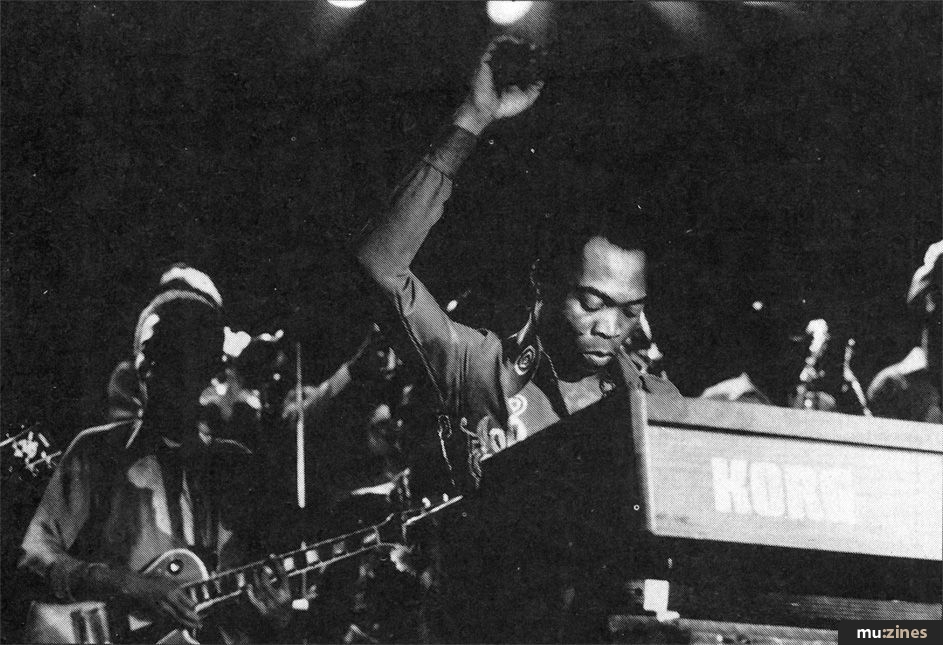
The King of Juju rocks it
Fela actually became prominent before King Sunny Ade did, though now it's Ade who holds decisive sway in the international sweepstakes. But even before Bob Marley's death in 1981, some critics were calling Fela "the next Marley" of third world Pop: His Afrobeat is the most Westernised of Afro-pop musics, and the most pugnaciously political. He sing-speaks in pidgin English, a sort of Yoruban counterpart to Jamaican patois. After his early highlife Jazz band days in the mid-'60s, Fela found himself on a sojourn in LA with black nationalist singer Sandra Isidore. She radicalised him, and he changed his name from the given Fela Ransom Kuti to Fela Anikulapo Kuti and began drawing up his pan-Africanistic ideology. And he began making some of the hottest, most viciously danceable protest music on the planet.
Fela's Afro-beat is dance music as political weapon, the Afro-funk orchestra as herd of charging rhino. From the first Fela LPs with Africa 70 to his recent discs with the ensemble he now calls Egypt 80 (there are some 30 Fela LPs in all, about half of which are available here as imports or, in a few cases, domestically), Fela has stuck to a fairly rigid formula of sidelong cuts. But what a formula; jittery funk-scratch rhythm guitars and serpentine tenor guitars playing bass-like repetitive single-note runs are joined by bass, traps, congas, cowbells, maracas, sticks (a stick struck on a small wooden box, à la claves), and shekere (a bead-covered gourd that hisses and rattles when shaken) to form a smoldering wall of muscular Afro-vamps, as Fela searches his organ or clavinet or piano in staccato, fractured-bebop bursts, bobbing and weaving soon building a compelling, insistent melody. As the tension builds to the breaking point, Fela will cue in his horn section, anchored by the full-throated bull-elephant roar of longtime bandmaster Lekan Animashaun's baritone sax, for a heraldic, dissonant, James Brown-meets-Sun Ra fanfare. Then Fela will solo in free-form style on sax, locking horns with the surging riffs and roistering bleats of his brass unit. Then the horns will part and the simmering massed rhythm section will take over again, as Fela steps forward to rant and rap, spicing his gleefully mocking diatribes against the authorities with hoots and chortles of derision, answered all the while in feverish call-and-response by up to a dozen of his wives (whom he calls his queens).
And when Fela spits out his anti-authority raps, he's not assuming any ideological poses. Ever the recalcitrant maverick, he's been arrested hundreds of times.
Item: In 1976 Fela, fed up with governmental persecution, established his own private compound, Kalakuta Republic, on the outskirts of Lagos. In February 1977, the Nigerian army savagely raided Kalakuta, beating Fela and his band-members bloody, beating and raping many of his wives (who then numbered 27), even shoving his 78-year old mother out of a window, causing injuries that led to her death soon after. Fela described th whole hideous scene on the subsequent Kalakuta Show LP.
Recently recorded evidence points to welcome expansions of Fela's trademark musical formula. Capitol's double-LP Live in Amsterdam, recorded in November 1983, features not only one cut with the all-time classic Fela title (Gimme Shit I Give You Shit), but also Custom Checkpoint, with clattering, splayed polyrhythms, daringly dissonant horn intervals, oddly spidery guitar lines and a Punk-rock pace — Fela goes Beefheart, or harmolodic.
So it was with more than the usual excitement that Fela's announced New York show was anticipated. Of course, things didn't turn out as expected, but Egypt 80 finally did perform. And despite sound-system problems that delayed and interrupted the show, it worked out pretty well anyway. Fela's son, alto saxist Nana Femi Anikulapo Kuti, led the band and delivered an appropriate speech at the outset:
"Of course, the man who is supposed to be here is not here. That is proof of what we say: that for Fela, music is not entertainment, music is politics, it is a weapon, it is a way of life. So when we play for you, we do not play to entertain you. Mainly, we play for Fela."
Then that marvelously untamed Fela groove was let loose for some 90 minutes, and it was good. When the 12 queens came out in face paint and outrageously colourful and skimpy tribal-bikini gear, and executed some X-rated bush-dance gyrations along the front of the stage, well... And then with Femi looking like a dead ringer for his father, grabbing the microphone defiantly to prowl the cramped stage... well, it was the next best thing to having Fela himself there, and you had to hand a pyrrhic victory, at least, to Egypt 80.

The President of Afro-Pop finds the lost chord
A week before Egypt 80 finally performed, Sunny Ade entranced a capacity throng at an outdoor West Side pier with the lilting, cascading polyrhythms of his Juju music. If Fela's Afro-beat is brazenly masculine, Ade's Juju is uncannily feminine. Yes, it does work up to a fairly heated turbulence at times, but it's dominated by a unique delicacy, grace and suppleness. Ade's Juju represents perhaps the most deeply African treatment of Western influences in all of Afro-pop, the most exotically sophisticated and intricately polyrhythmic in its multi-leveled, ever-evolving communal give-and-take. That refinement, plus the usual extended-jam format of most of Ade's tunes and the fact that his mellifluous choral vocals are chanted in Yoruba and not English, make it somewhat surprising that King Sunny has become the popular champion of Afro-pop. But then he and his music are much sweeter than Fela and his; Ade seduces rather than overpowers. And maybe the exoticness and extended-jam format work in his favour — maybe some people hear his Juju as a distinctive new flavour of fusion music, which in some senses it certainly is.
Ade's Juju has been recorded on hundreds of Nigerian LPs, some 12 million of which have been sold in his homeland. His latest, Aura, is his best yet, matching the colouristic breadth of 1982's Juju Music and the harder drive of 1983's Synchro System, even featuring Stevie Wonder's harmonica on the opening track, Ase.
But King Sunny and his 20-piece African Beats are best experienced live, where they like to extend the jam as much as possible, which has caused some to liken them to the Grateful Dead. At that pier show, Ade kicked things off with an anatomy-of-the-magic-of-Juju lesson, as his players emerged one by one to add their piece to the murmuring, burbling, chattering, mosaic: first a tenor guitarist, then two rhythm guitarists, then bass guitar, solo guitar, pedal-steel guitar, two conga drummers, two talking drummers, trap drums, and men on cowbells, maracas, claves and shekere. Plus six singer/dancers. And King Sunny himself on Fender Telecaster and Stratocaster, and occasionally, a Gibson Les Paul.
Ade frequently claims the spotlight with his guitar runs, quickly flicking a few stiffly extended fingers back and forth over the strings for a dulcimer-like tone and attack. But it's the ensemble that's the thing, playing with an ever-shifting delicious, liquid flow. The performance ended with a talking drummer conversing deeply with the crowd's euphoric clapping, chanting and stomping.
A week later IM&RWinterviewed King Sunny Ade. He wears his title well: Soft-spoken, polite, yet somehow commanding and authoritative, he exudes regal demeanour as easily and effectively as he entrances American audiences.
How long has the band been together, and how do you get it so tight?
"Oh, thank you very much. We have been together since 1966. I had the Green Spot Band then. 10 pieces. We soon became African Beats — 820 pieces! But for about 18 years or so, the same personnel, with only a very few changes. We play and rehearse all the time. That's all that we do."
How do you cue the band without making any obvious gestures on stage?
"I do not like to be obvious, like, how some will start a song with 'One, two, three, four!' I start off a song any way I like. Sometimes I might tell the drummer something like this: [stares straight ahead, then blinks four times]."
You get some very interesting guitar sounds. Do you tune the guitars in any special way?
"No. Mine is tunes to an open chord, like for the bottleneck guitar. And I uses a capo in certain places. The other guitarists are all tuned normally. It must be in the way we play. That is the thing about Juju music: Only the African can play it properly, really. That is why, though I like and appreciate the American and European musicians I have heard who integrate the Juju and African musics, it is important for people to hear the real thing. So, I am most grateful for their introduction!"
What do you think of Fela?
"He is a great man, a great musician and a good friend. It is a terrible thing what happen to Fela now in Lagos. But it always happen to Fela! You see, he has his own political party, and with another government in power as we have in Nigeria, you can imagine they don't like Fela much!"
You're very popular in Nigeria, and probably pretty influential. Isn't there anything you could do to help Fela out?
"Well, I wish I could help, but this has happened so many times already with Fela; they always come down on him. I do not get involved this time because I am not fully aware of what has happened. But it is all politics anyway — and I do not get involved in politics."
Even though he claimed he couldn't help, in reality it's largely due to King Sunny's groundwork that Egypt 80 appeared in America at all. If all goes well, maybe one day soon Fela himself will finally make it to these shores again. Indeed, a week after Egypt 80's show, stories circulated that Fela had been fet out of jail the very day of that show and promptly called a press conference, and was then thrown back in jail for five years, for "defaming the government." Let's pray for the day we can see a most happy Fela ranting about that one from atop his charging musical beast.
Publisher: International Musician & Recording World - Cover Publications Ltd, Northern & Shell Ltd.
The current copyright owner/s of this content may differ from the originally published copyright notice.
More details on copyright ownership...

International Musician - Mar 1985
Donated & scanned by: Mike Gorman
Feature by Michael Shore
Help Support The Things You Love
mu:zines is the result of thousands of hours of effort, and will require many thousands more going forward to reach our goals of getting all this content online.
If you value this resource, you can support this project - it really helps!
Donations for April 2026
Issues donated this month: 0
New issues that have been donated or scanned for us this month.
Funds donated this month: £0.00
All donations and support are gratefully appreciated - thank you.
Magazines Needed - Can You Help?
Do you have any of these magazine issues?
If so, and you can donate, lend or scan them to help complete our archive, please get in touch via the Contribute page - thanks!
Please Contribute to mu:zines by supplying magazines, scanning or donating funds. Thanks!
Monetary donations go towards site running costs, and the occasional coffee for me if there's anything left over!

 @mu_zines
 RSS Feed
 Blog
Blog