BeeBMIDI (Part 3)
(EMM Aug 84)


Magazine Archive
Home -> Magazines -> Issues -> Articles in this issue -> View
DX-MAX Expansion Board | |
Article from Music Technology, March 1987 | |
If you're afraid the MkII DX7s are going to turn your prized machine into an antique curiosity, the DX-MAX could put your mind at rest. Chris Many checks out a mod for old DXs that offers many of the features of Yamaha's new babies.
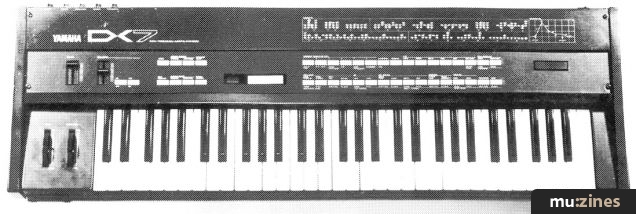
THIS IS ONE of several expansion boards currently available for the DX7, one which adds a number of features to your favourite (if recently discontinued, see elsewhere this issue) FM synth. Although not as wide-ranging in scope as, say, Grey Matter Response's E! board, DX-MAX is still quite a neat achievement.

A relatively simple installation procedure calls for you to open up your DX, remove three chips and insert the DX-MAX in their place. Unfortunately, the board has to partly slide under a long piece of aluminium which separates the keyboard from the DX's motherboard, and it's a bit of a hassle unless you remove the metal separator. To do this, you have to remove the keyboard to get to the screws that hold the aluminium in place.
Once you've navigated these points, and after carefully prying out three easily identifiable IC chips, you position the DX-MAX card so that the main EPROM fits in one of the original slots.
When you now power-up your DX, the LCD shows that DX-MAX is installed and you're ready to go. All the added features are accessed by first depressing the Function button and then pressing either button 12 or 13 (these are normally unused by the DX7's operating system). These buttons now cycle you forwards or backwards through the new features.
First off, you now have eight banks of 32 sounds available onboard. That's 256 patches instantly at your command, with no loading from disk or cartridge. Additionally, you have the option of storing function parameters for each voice, plus additional features included with DX-MAX. So not only do you have the sounds available, but also any function parameter settings for each individual patch. This doesn't limit your number of voices, so there is still a total of 256 voices and functions available for storage.
If you are using your DX as a master controller, you'll now be able to send on any of the 16 MIDI channels directly. Bear in mind that any DX-MAX function can be stored in its function memory, so you can now set up patches that include a MIDI channel number - a very handy feature, especially in live situations with multiple-synth setups.
Upper and lower key limits are now programmable, and although you can't combine two patches on either side of your limit point, you can at least simulate a split mode on your DX if you're MIDI'd to another synth. Just throw a bass patch up and limit it to a high note of G2 or C3. Your right hand can play anything above the high limit, and it will be muted on the DX but not on any external synths.
Another feature included (although I don't really see much use in this one) is programmable volume levels for each voice. I don't know anyone who owns a DX who doesn't own a footpedal as well. But for those who want to set an output level for the whole patch, you can specify it between 0 and 7.
The last feature is a new Poly mode, where you can stack voices and detune them individually to achieve harmonies and chorusing. Three modes are used: 16x1 (the standard DX 16-key polyphony, one note per key); 8x2 (eight-key polyphony, two notes per key); and 4x4 (four-key polyphony, four notes per key).
Each note can be tuned within a four-octave range (+24.99 to -24.99), so chordal lines can be achieved by tuning each stacked voice to the appropriate interval. Or detune each one slightly to achieve a chorusing effect. Again, any of the special features can be saved within the fuction memory of DX-MAX, so new versions of traditional FM sounds can be stored on a single DX.
Regular DX cartridges can still be used with the expansion board, and you can save sounds to cartridge just as you always do. You can also use cartridges saved using DX-MAX with standard DXs, but be sure certain functions are set to 0 for the 32nd memory, otherwise you'll get a format conflict. A small price to pay for stored voice and function parameters on a cartridge.
I had little problem installing my DX-MAX (I'm no tech wizard, either), and it worked as promised, right from the start. I got a little worried when I put in a cartridge, pressed a key and got no sound, but a rapid search through the skimpy documentation (four pages) revealed that all the function values are set to zero (Volume = 0, high limit key = C2) when you first attempt to load a ROM/RAM cartridge. It's easy enough to fix (just set the board to read Voice Only), but my heart definitely skipped a beat.
Overall, the best feature of DX-MAX is the immediate expansion to eight banks of 32 voices. But almost every one of the other additions comes in handy at one time or another. DX-MAX is a nice addition to your DX7, and although not as powerful as some other expansion boards, it certainly expands the power of your DX a few notches.
Price £249 including VAT
(Contact Details)
Featuring related gear

BeeBMIDI (Part 7)
(EMM Mar 85)


Hands On: Yamaha DX7
(SOS Dec 92)

Load Baring
(12T May 85)

Load Baring
(12T Aug 85)

One For The 7 - DX7 Patch
(ES May 85)

One Off - DX7 Patch
(ES Apr 85)


Sight Reading - Yamaha DX7 Digital Synthesizer
(EMM Apr 85)

Steve Gray on the DX7
(EMM Dec 83)

The Right Connections
(ES Oct 84)

The Synths Of The Year Show - Synthcheck
(IM Dec 85)

Understanding the DX7 (Part 1)
(EMM Apr 84)

Understanding the DX7 (Part 2)
(EMM May 84)

Understanding the DX7 (Part 3)
(EMM Jun 84)

Understanding the DX7 (Part 4)
(EMM Jul 84)

Understanding the DX7 (Part 7)
(EMM Oct 84)

Patchwork
(EMM Feb 84)
Patchwork
(EMM Mar 84)
Patchwork
(EMM Apr 84)

Patchwork
(EMM May 84)

Patchwork
(EMM Jul 84)

Patchwork
(EMM Aug 84)
Patchwork
(EMM Jan 85)

Patchwork
(EMM Feb 85)
Patchwork
(EMM Apr 85)

Patchwork
(EMM Jun 85)

Patchwork
(EMM Jul 85)

Patchwork
(EMM Feb 86)

Patchwork
(EMM Mar 86)

Patchwork
(EMM May 86)
Patchwork
(EMM Jun 86)
Patchwork
(EMM Aug 86)

Patchwork
(EMM Sep 86)

Patchwork
(MT Nov 86)
Patchwork
(MT Dec 86)

Patchwork
(MT Jan 87)
...and 19 more Patchwork articles... (Show these)
Browse category: Synthesizer > Yamaha
Publisher: Music Technology - Music Maker Publications (UK), Future Publishing.
The current copyright owner/s of this content may differ from the originally published copyright notice.
More details on copyright ownership...

Music Technology - Mar 1987
Gear in this article:
Review by Chris Many
Previous article in this issue:
Next article in this issue:
Help Support The Things You Love
mu:zines is the result of thousands of hours of effort, and will require many thousands more going forward to reach our goals of getting all this content online.
If you value this resource, you can support this project - it really helps!
Donations for October 2026
Issues donated this month: 0
New issues that have been donated or scanned for us this month.
Funds donated this month: £0.00
All donations and support are gratefully appreciated - thank you.
Magazines Needed - Can You Help?
Do you have any of these magazine issues?
If so, and you can donate, lend or scan them to help complete our archive, please get in touch via the Contribute page - thanks!
Please Contribute to mu:zines by supplying magazines, scanning or donating funds. Thanks!
Monetary donations go towards site running costs, and the occasional coffee for me if there's anything left over!

 @mu_zines
 RSS Feed
 Blog
Blog