Tuned in & Turned on - In-Ear Monitoring Enlightenment
Live, Performing
(STG Feb 97)


Magazine Archive
Home -> Magazines -> Issues -> Articles in this issue -> View
The Sound Of Simon | |
Paul SimonArticle from Sound Engineer and Producer, June 1987 | |
Paul Simon's Graceland concert posed awkward problems for the sound crew. Simon Croft listened hard
The sound crew for Paul Simon's Graceland concerts in London had to contend with the combined problems of the Royal Albert Hall and an array of unfamiliar instruments and musicians. Simon Croft talked it through with Dave Morgan and Dave Staub
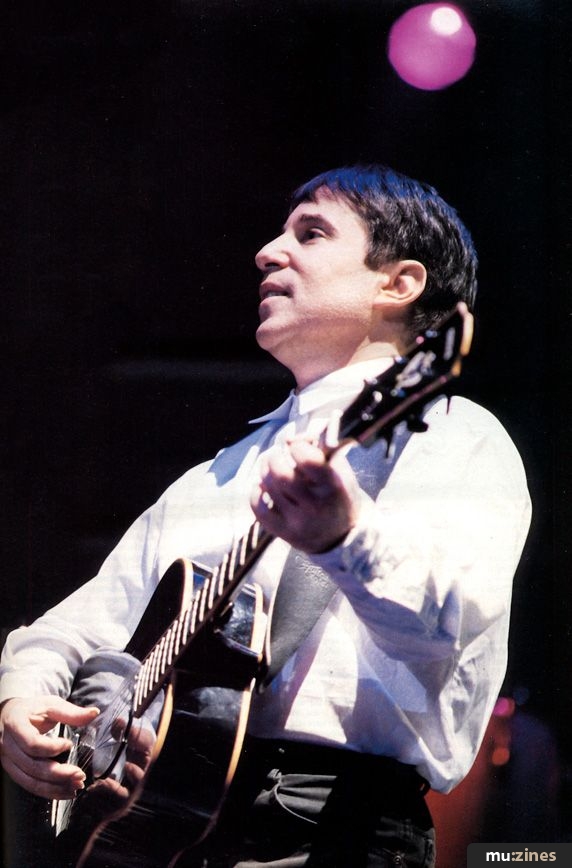
The SE+P position was far stage left, so if it sounded good there it was going to sound good anywhere in the Royal Albert Hall. It sounded very good indeed. The sound balance was impeccable throughout and the natural acoustics helped create a depth that was surprising considering the PA was run in mono.
As this was effectively music in the round, any attempt at stereo would have created large areas where the audience could only hear half the mix.
'This has been the opportunity of a lifetime for the band, Paul Simon and the whole production. It's something none of us will ever forget,' Dave Morgan, the front of house mixer, said earnestly. After working with Whitney Houston before the Simon tour, Morgan has had plenty to make comparisons with. He'll be on the road with Houston again when Simon's show finishes on July 14.
By any standards, the show was an extraordinary event. In two-and-a-half hours, seemingly endless permutations of the 25 musicians performed on stage. At any time, there were as many as 14 vocalists.
'It is hard work,' Morgan conceded. 'There are 50 transducers to set up and test every day. Sound checking takes a long time because there are four different units: the band, Ladysmith Black Mambazo, Hugh Masekela and band, and Miriam and her singers.'
To make life a little more complicated, there are rehearsals and sound checks because some of the numbers have developed during the tour. The running order varies each night. So as far as Morgan is concerned there is one answer: 'knowing the cues'.
Apart from rapid changes in levels and mic configurations, Morgan also handles a wide variety of reverb treatments. There are six programmes in the AMS, another six in the 224 and eight in the Super Prime Time. These change on every song, making each sound unique.
'While every song is different to me, the audience has never heard African music before. There could be a similarity to the music if I didn't make a deliberate attempt to make each song sound different. On a lot of songs we're trying to reproduce accurately what Roy Halee did in the studio.'
Halee was the engineer for the Graceland album and worked with Morgan during rehearsals on the AMS and Lexicon programmes. At a few points during the show, Wendell drum-replacement units are also used, loaded with samples from the album itself. Morgan did not feel that signal processing was incompatible with largely acoustic music.
'I'm not trying to do a great deal of unnatural enhancement,' he explained. 'It's mostly to maintain space in an enclosed room and give better articulation.'
In that respect, the acoustic of the Royal Albert Hall proved appropriate. Although it has a long decay time, the distribution across the frequency range is even. Morgan described it as beautiful for vocals but said it was far more suited to the reasonable volume levels they were using than all-out rock and roll.
While the music did not require high volume levels, even coverage was essential. All seats were sold every night, so there was a need for full dispersion at almost every angle. Here the Royal Albert Hall proved less advantageous, as running the PA in stereo would have created phase problems within the circular structure and given large sections of the audience a less-than-optimum sound balance. Despite the fact that the system had to be run in mono — and much of the outboard had been specifically assigned to stereo enhancement — there was a remarkable sense of separation. It was a clear testimony to the engineering skills of Dave Morgan and the accurate reproduction of the MSI system.
'I feel it's the most accurate system around,' Morgan affirmed. 'It's the system I want to use. I enjoy a good relationship with Bob Goldstein, the owner, as well as Brian Grant and Robbie Williams at Brit Row. I feel I get the best equipment from them as well as the best service.'
Marilyn Sound and Britannia Row have reciprocal arrangements, so the same equipment can be supplied either side of the Atlantic. But the MSI service goes beyond MSI manufactured systems. The Graceland ensemble recently played a stadium in Zimbabwe, using what Morgan described as a guitar-store PA.
Two MSI engineers went over before the gig and made sure that the equipment, made by another company, gave its best.
'I just walked into a PA that worked perfectly; everything was in phase and all the amps worked. It was marvellous.'
More impressive than the PA was the audience within the sun-drenched stadium. An even mixture of black and white, some of whom had come from as far as Johannesburg to enjoy this unique blend of music. Even the president of Zimbabwe attended.
Addressing the political issues that have surrounded this tour, Morgan said: 'All this talk of boycotts, everything just disappeared in the beauty of the music and the day. It was the best retort to people who criticise this tour for exploiting the South African sound or musicians.'
The next day, the Graceland tour was to take its message to more parts of the world. That Tuesday the equipment would be set up at RDS in Dublin ready for a live broadcast to Tokyo on Wednesday morning and a show in Dublin in the evening.
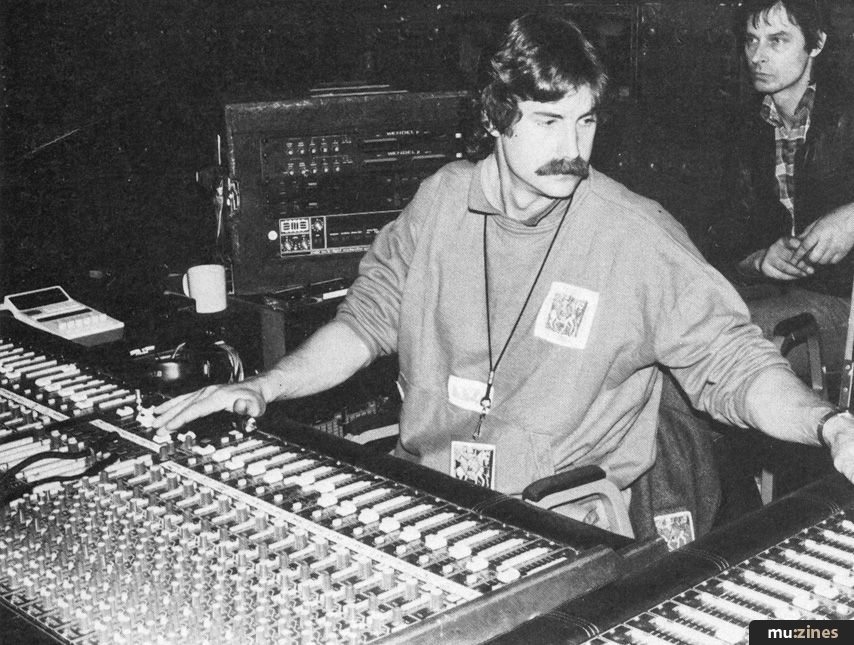
Dave Morgan: 'something we will never forget'
DRUM KIT
Bass Drum: Beyer M88
Snare (Top): Shure SM57
Snare (Bottom): Beyer M201
Overheads: AKG C414 (2)
Toms: Shure SM98
Dave Morgan: 'I've been using the new Shure SM98 mini-condensers on tom toms. We've found those to be truly remarkable. They are a little over an inch long and take a whopping amount of signal with no break-up problems. It's like having 414s or U87s on the toms but without the worries — they're so small, he's never going to hit them.
'And you don't have to worry about a microphone that costs $1200. They have add-on pattern modifiers and the hypercardioid creates enough rejection to use on five toms. The damn things sound like cannons, it's just beautiful.'
PERCUSSION
Congas: 409
Timbales: AKG C421
Talking Drum: Shure SM98
'We have three African drums that I hadn't miked before: large wooden drums with natural skin heads that are held together with gut. On the largest drum I put a 409 and the two smaller drums sounded best with 57s.
'On Assante there's a pair of C451s for his cowbell tree, woodchimes and various birdcalls. I asked the percussionists if they would wear Countryman EM 101 omnis on their wrists but both Francis and Assante said no.
'Francis does a lot of interesting work with the rims of his timbales and a cowbell tree. We've got a 57 looking across, which picks up the metallic sound well. Underneath the timbales are a pair of 421s. I've never had to mic top and bottom with timbales before.'
OTHER INSTRUMENTS
Bass Guitar: Two BSS DI boxes running from a stereo chorus
Electric guitars: Shure SM57
Keyboards: DI except accordian.
'The accordian presented some problems for monitoring but we ended up with a combination. I use two EV RE20s for the house and we had a problem getting enough low end in the monitors without feeding back. We didn't want to use a pick-up or mount microphones inside the accordian because it could be really nasal sounding.
'So we ended up taping a Countryman Isomax II on the low end. That worked well for the monitor. I don't want that much low end out front so I don't take it.
'In Paul's guitar we've got a Sennheiser wireless system with their mini-condenser lavalier mounted inside.'
VOCALS
Ladysmith Black Mambazo (male vocal): Nady wireless with Countryman transducer on headset for leader Joseph Shabalala; five Shure SM78 between other eight singers.
'They sing very quietly, so we needed something that had good feedback rejection and the SM78s are a little more transparent than the SM58s. The singers are six to eight inches away from the microphones.'
Female singers and guitarists' vocal mics: Shure SM58.
OUTBOARD GEAR
Two BSS DPR402 compressor/de-essers: wireless vocals (Joseph and Miriam).
dBx 165A compressor: vocals, Paul Simon.
dBx 160x compressors: female vocals.
Aphex cards with comp/gates: bass drum, snare and bass guitar.
AMS RMX16: drum sounds.
Lexicon 224XL.
'I've used the two BSS DPR402s to get easy compression and the little bit of de-essing you need on those wirelesses.
I use the Split programmes — one side predominantly for snare drum effects. When I'm using the AMS for snare, it becomes the tom tom side. The other side is for vocals, synthesisers and percussion.'
Eventide 949: used to synthesise stereo for background vocals and electronic keyboards. (US shows use an AMS 1580S).
Lexicon Super Prime Time: Simon's vocal and Hugh Masekela's trumpet.
Yamaha SPX90: stereo spread on saxophones.
Two Wendell Jnrs: occasional sampled snare and bass drum from Gracelands album.
MONITOR SYSTEM
Midas 32 channel Pro 40 and 18 channel Pro 2 desks: 12 monitor mixes, with the Pro 2 used primarily for submixing percussion and the Ladysmith vocals.
Monitors: mainly Marilyn Sound wedges containing two 12-inch drivers and a horn bi-amped with a proprietary time aligned crossover; two small Meyer UMI monitors for Paul Simon. Larger wedges for drum kit, originally designed by North West Sound (now part of Marilyn) and containing two 15-inch drivers and a horn.
Side fills similar to PA units, containing two 15-inch, one 12-inch and a horn in a single enclosure.
Dave Staub, monitor mixing: 'The difficult part of this gig is being in a hall designed for orchestral music. The monitors, performers and PA are all in a room — everything bleeds into everything else. Paul's a very quiet singer and it's difficult to get him above the house level.
'There are a lot of cues. The trick is to get the gain structure on all the instruments just right. If the players get it right, it will pretty much mix itself. I still have a fair number of cues but I've cut them down since I started the show.
'In a room like this, there is no place you can put the monitors where they aren't going to play into the room. It's not so much a feedback problem, the monitors excite the room and create sound problems without the PA on.
'So the idea is to get the monitors as low as you can but still get the band to wear them. Rooms like this are a real monitor mixer's nightmare.'
FRONT OF HOUSE AMPLIFICATION
Amplifiers: Custom modified SAE on bass and low mid, modified Crest on high end.
Speakers: MSI Hi-Pack/Lo-Pack; 19 Hi and 10 Lo flown in three clusters; one Hi and one Lo box at stage level each side of stage.
Dave Morgan: 'Our rigger Aidan Bradley had the hardest job, working with so few anchoring points. He also had the problem that it's 150 feet up to the steel. We used approximately 2,200 feet of steel to fly the equipment.'
In an ideal world, the speakers would have been flown higher. 'I made some concessions to the lighting system because of the rake on the roof. Everything is aimed down and I've tried to equalise the path length to everybody. This compromise has worked well.
'We had to attenuate the side stacks somewhat to compensate for the distance. But the phase difference wasn't enough to justify delaying the side stacks. We kept the horns from intersecting at the points where the phase would have been a problem.
'The show is in mono here because we're covering 270 to 290 degrees. It's really not fair to expect the people on the sides to listen to one side of the stereo mix. Because the Royal Albert Hall is round, the sound tends to push itself around the building. If you went hard left and right there would be a lot of cancellation.
'The coverage also worked better with the PA split in three clusters rather than four. So we have a centre cluster and two side clusters, instead of left/right front and left/right sides.
Front of house desks: Two Harrison Alives.
'I needed 64 channels but I also needed to be well within a small space and I needed very good fidelity. The Harrison seemed to satisfy all the requirements.'
More with this topic
 |
 Bad Gigs |
 Live End - Live Music For The Hi-Tech Musician |
 Moor Music - Heathcliff: Behind the sound |
 Tour de Force - Celine Dion Live |
 Lip Service - When, Where, and How to Mime |
 Practical PA - Part 1: Introduction To PA (Part 1) |
Trip Around The World - TOKYO |
 PA Column |
 Relax... your solo will be just fine - Relaxing For Gigs |
 Set List Science |
 Vive Le Difference! |
Browse by Topic:
Live
Publisher: Sound Engineer and Producer - Media Week Ltd.
The current copyright owner/s of this content may differ from the originally published copyright notice.
More details on copyright ownership...

Sound Engineer and Producer - Jun 1987
Donated by: Chris Maund
Feature by Simon Croft
Previous article in this issue:
Next article in this issue:
Help Support The Things You Love
mu:zines is the result of thousands of hours of effort, and will require many thousands more going forward to reach our goals of getting all this content online.
If you value this resource, you can support this project - it really helps!
Donations for August 2026
Issues donated this month: 0
New issues that have been donated or scanned for us this month.
Funds donated this month: £0.00
All donations and support are gratefully appreciated - thank you.
Magazines Needed - Can You Help?
Do you have any of these magazine issues?
If so, and you can donate, lend or scan them to help complete our archive, please get in touch via the Contribute page - thanks!
If you're enjoying the site, please consider supporting me to help build this archive...
...with a one time Donation, or a recurring Donation of just £2 a month. It really helps - thank you!

 @mu_zines
 RSS Feed
 Blog
Blog