An Old Pro - Steinberg Pro24 Amiga
(SOS Feb 91)




Magazine Archive
Home -> Magazines -> Issues -> Articles in this issue -> View
Steinberg Pro-24 | |
Software V1.1Article from Sound Engineer and Producer, October 1986 | |
Used with the Atari 520ST this proves to be one of the most powerful MIDI based recorders available: Curtis Schwartz examines its latest software updates

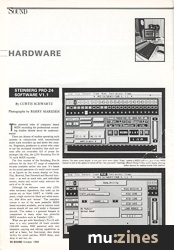
The main screen display. A new pull down menu called "Flags" enables a MIDI click to be sent to any MIDI channel as well as the option to switch off the "Are you sure?" warnings.
The potential roles of computer based MIDI recording for professional recording studios should never be underestimated.
There are dozens of studios operating such systems in conjunction with conventional multi track recorders up and down the country. Engineers, producers or artists who come to use the increased versatility that such systems offer are invariably full of praise for packages like this, the £250 Steinberg Pro-24 24 track MIDI recorder.
The first version of the Steinberg Pro-24 software for the Atari ST range of computers became available earlier this year. It's based on the actual operation of a multi track recorder; as figures on the screen display are Stop, Play, Rewind, Fast Forward and Record functions — as well as track solo, and individual meters, mutes and record ready selectors for each of its 24 tracks.
Although the software costs only £250, other necessary ingredients that make up the system are an Atari 52OST or 1040ST computer, a high resolution black and white monitor, disk drive and 'mouse'. The complete system is one of the most powerful MIDI based recorders available, and at current retail prices should all cost well under a thousand pounds. This makes it a genuine bargain in comparison to many other less powerful MIDI recorders such as Yamaha's QX1.
What you get with Steinberg's Pro-24 software is a very powerful 24 track recorder (200,000 events, 5000 patterns) with very extensive copying and editing capabilities as well as a basic, but functional, data dump facility for synth patches, MIDI delay, auto drop in and out, etc.

Dump Utility screen display showing added features for loading sounds from modules.
SOFT TOUCHES
Before elaborating on the individual features offered by the software, I'll outline some of the different ways in which it can be used to enhance more conventional recording techniques.

Image credit: Barry Marsden
Firstly, when synchronised to a multi track machine (via a sync box such as Roland's SBX-80, Bokse SM-9 or Steinberg's own MTS synchroniser) it can, of course, be used to increase the number of available tracks. Therefore the multi track tape machine could be used to record all acoustic instruments, vocals etc., and the Pro-24 would record anything that is MIDI-linkable such as samplers, keyboards, drum machines, MIDI effects program changes and desk automation (for the new breed of MIDI consoles).
Drum machine hi-hats, cymbals, shakers, etc. would no longer need to be recorded onto tape. This obviously gives the advantage of a cleaner sound, increased analog track availability and reduced tape hiss as such instruments invariably require HF boosts in the mix.
A second use for the Pro-24 (with synchroniser) would be as a versatile and cheap means of pseudo video-to-recorder synching. If you are recording a soundtrack to a video, then even a VHS cassette with timecode on its audio track could be used as a master controller for the Pro-24. In this way you could synchronise perfectly all musical and sound effects cue points to the video. When, either a satisfactory outline or complete recording is made (depending on how many MIDI sound sources you have), the recording could be transferred with time code either to multi track (if you need to record more over-dubs than your MIDI instruments can play at one time) or record the finished product direct to two track.
The Pro-24 also reveals its strength in its ability to work as a multi track recorder with the enormous versatility that a powerful sequencer offers composers, arrangers and producers.

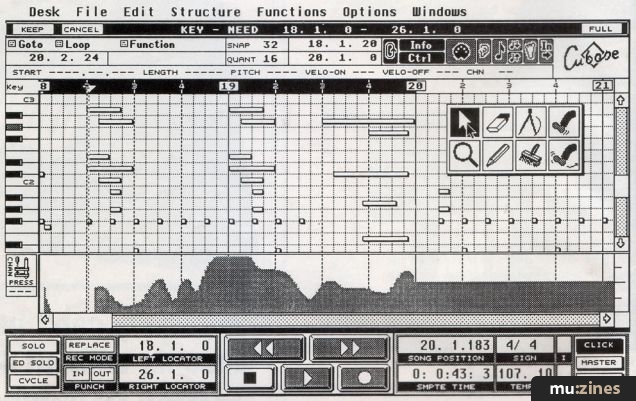
Note Edit page showing new "Range Select" function. This is very useful for selecting sections to be quantised/transposed/edited without altering other parts of the pattern.
Whilst being able to record different drums and instruments on individual tracks you can then copy the complete sets of tracks that make up a chorus, for example, to a different part of a song; then try out a Intro/Verse/Chorus/Verse arrangement, and if it doesn't work then swap the different sections around at the press of a few buttons.
These are just a few of the ways in which I have been using the Pro-24 software — sometimes synched to multi track or video, and sometimes as a stand alone system.
The Atari ST computer not only has built in MIDI ports (therefore you don't need to buy an extra MIDI interface unit for the computer), but it also has a very large memory capacity. Even when using the Pro-24 with the standard Atari 520ST, the memory capacity could be in excess of 200,000 notes. The latest version of the software uses more of the Atari's memory, so therefore reducing slightly its total memory capacity.

The track list: the new software allows you to print this out.
The number of features that the first version of the software offered was very comprehensive. Every note recorded on each of the 24 tracks can have its position, velocity, duration, pitch and any other piece of MIDI information altered to the minutest detail on a unique and very handy screen display. Whole patterns can be quantised, filtered from any type of MIDI data and have their pitch and velocity information transposed. There are at least six different ways to copy patterns, tracks, sets of tracks and complete songs, and in addition to having track listings, MIDI configuration menus, MIDI delay (offering repeat delay effects) the Steinberg has a data dump menu for transmitting/storing whole sets of DX7 voices, for example.

Soft touches at Berry Farm Studio.
Image credit: Barry Marsden
Steinberg has already produced an update to the Pro-24 software with some very useful new additions. This is a short run down of some of the new features that the V1.1 Pro-24 offers:
• Copying of parts of patterns and not only complete patterns.
• Transmission of a MIDI 'Click' via the MIDI bus.
• A more comprehensive track list menu enabling the 'dragging' of patterns to the desired functions.
• Continuous cycling without stopping.
• A pattern merge function for bouncing down.
• Output to printer of track listings.
• Also many new additions to the Edit Mode such as Range Setting, editing whilst playing the other tracks, playing event data whilst editing, and velocity and note transposition.
I have kept the list of new features very brief because if you are already a Pro-24 user then the descriptions should make sense, and if you are not a Pro-24 user, then I would need many more pages to attempt to describe the original features in the first place in order for their variations to make any sense.

The Multi-Copy page: you can now copy sections of patterns to create new ones.
CONCLUSION
Suffice to say, the Steinberg Pro-24, in either its original or revised form, is an extremely powerful studio tool. It has numerous uses within the professional recording studios as well as for home based musicians.
Whilst it is not the kind of product that one can be expected to master in an afternoon if you are willing to spend the time to get to grips with it there are many areas in which it could become enormously useful – and invaluable.
Also featuring gear in this article


Macintosh or Atari?
(SOS Jan 88)
School's Out
(MIC Aug 89)

Software Tracking - Steinberg Pro24 Software
(EMM Sep 86)

Steinberg Pro 24 - SoftwareCheck
(IM Oct 86)


Steinberg Pro24 Version III
(SOS Aug 88)

Steinberg Software Page
(SOS May 88)

Steinberg Software Page
(SOS Jun 88)

Browse category: Software: Sequencer/DAW > Steinberg
Featuring related gear

Clash of the Titans
(MIC Oct 89)

Cubase 2.0
(SOS Dec 90)

Cubase In-depth
(MIC Jan 90)

Cubase MIDI Mixer - Programming Clinic (Part 1)
(SOS Oct 92)

Cubase MIDI Mixer - Programming Clinic (Part 2)
(SOS Nov 92)
Dirty Dozen
(MIC Jun 89)

Dream Sequences (Part 1)
(MX Dec 94)

Dream sequences (Part 2)
(MX Jan 95)

Dream Sequences (Part 3)
(MX Feb 95)

Dream sequences (Part 4)
(MX Mar 95)

Dream sequences (Part 5)
(MX Apr 95)
Dream sequences (Part 6)
(MX May 95)
Dream sequences (Part 7)
(MX Jun 95)

Hands On: Steinberg Cubase
(SOS Jan 92)

High Noon! - Steinberg 'Twelve' MIDI Recorder
(SOS Feb 89)



Browse category: Software: Sequencer/DAW > Steinberg
Publisher: Sound Engineer and Producer - Media Week Ltd.
The current copyright owner/s of this content may differ from the originally published copyright notice.
More details on copyright ownership...

Sound Engineer and Producer - Oct 1986
Donated by: Chris Maund
Review by Curtis Schwartz
Ads for Gear in this article:


Help Support The Things You Love
mu:zines is the result of thousands of hours of effort, and will require many thousands more going forward to reach our goals of getting all this content online.
If you value this resource, you can support this project - it really helps!
Donations for September 2026
Issues donated this month: 0
New issues that have been donated or scanned for us this month.
Funds donated this month: £0.00
All donations and support are gratefully appreciated - thank you.
Magazines Needed - Can You Help?
Do you have any of these magazine issues?
If so, and you can donate, lend or scan them to help complete our archive, please get in touch via the Contribute page - thanks!
If you're enjoying the site, please consider supporting me to help build this archive...
...with a one time Donation, or a recurring Donation of just £2 a month. It really helps - thank you!

 @mu_zines
 RSS Feed
 Blog
Blog